Resume Writing – Text Block Size

One of the mistakes I see a lot of job seekers make is writing a resume with large blocks of text. A resume is a summary of person’s career and potential. It isn’t a biography. Unfortunately, some job seekers write with large blocks of text that are more appropriate to a book and than a resume.

One of the mistakes I see a lot of job seekers make is writing a resume with large blocks of text.  A resume is a summary of person’s career and potential.  It isn’t a biography.  Unfortunately, some job seekers write with large blocks of text that are more appropriate to a book and than a resume.

In the Military Resume Benchmarking Report we released this week, we reviewed the text block size of military resumes.  We found nearly 70% of the resumes utilized short bullets for writing about their experience. This is a great style for a resume.

For the research report we looked at three styles – bullets, short paragraphs and long paragraphs.  Resumes with long paragraphs had text blocks that were more than a third of a page long, with some paragraphs approaching a full page.  Short paragraphs had more than five sentences but were less than a third of a page long.  Bullets were typically one to two sentences long, but could be up to five sentences.

Short and concise bullets make a resume easy to scan and read.  Many hiring managers will scan your resume first.  This initial look may only last 15 to 30 seconds.  The goal is to decide if the resume is worth reading closely.  If your resume is written in large blocks of text, a hiring manager may not read the most significant elements.  Using bullets can direct the reader to focus on the most important information.

When writing with bullets, consider using titles for each bullet.  A title can highlight an important concept and draw attention to the bullets that are the most important.  Most resumes write bullets like this:

  • Implemented a project resulting in $200k in savings
  • Led a quality improvement program, reducing defects by 40%
  • Revised production scheduling procedures, improving on-time shipping performance from 96% to 98% while cutting inventory levels by 15%.

Adding titles can highlight the accomplishments and draw the reader’s attention to the bullets:

  • Reduced Costs: Implemented a project resulting in $200k in savings
  • Improved Quality: Led a quality improvement program, reducing defects by 40%
  • Improved On-Time Performance: Revised production scheduling procedures, improving on-time shipping performance from 96% to 98% while cutting inventory levels by 15%.

By adding the titles, the bullets have a clear purpose.  A hiring manager can scan just the titles and get an idea for the job seeker has done.

One caution with adding titles, bolding and other style devices that emphasize information is to use these devices infrequently.  There are a few job seekers that go overboard and end up bolding or italicizing almost everything.  This defeats the purpose.  If everything is emphasized, then nothing will stand out.
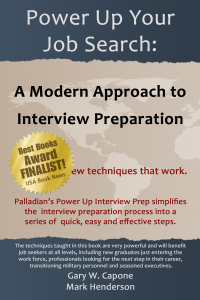
New Book Review

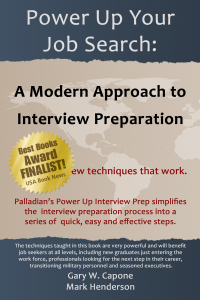
Read a review of our book, Power Up Your Job Search: A Modern Approach to Interview Preparation, from Norm Goldman, Publisher & Editor Bookpleasures.

Below is a copy of a review from Norm Goldman, publisher of Bookpleasures.  To to Amazon to get our Interview Prep Book.

Review: Power Up Your Job Search: A Modern Approach to Interview Preparation

By Norm Goldman Published April 23, 2009

With the job market in the dumps now may be the time to brush up on your interviewing skills in order to stand out from your competition. A step in the right direction would be to secure a copy of copy Power Up Your Job Search: A Modern Approach to Interview Preparation authored by Executive recruiters Gary W. Capone and Mark Henderson.

Capone and Henderson are founders and executives of Palladian International-an executive search firm that caters to a select group of companies who wish to identify and attract the highest performing individuals in order to separate them from those of mediocre skills. They specialize in working with manufacturing, distribution, sales, marketing and defense organizations for management and executive level positions.

They have put together an excellent and wide-ranging guide which, as they state in their introduction, was to create a tool that would “put all of their candidates in a position to communicate their skills, experiences and abilities honestly and effectively, enabling our clients to make the best assessment, and in turn, the best hiring decision.”

In order to accomplish this feat they have divided their guide into twenty-six lessons including invaluable exercises at the end of each. Covered are such topics as interview process, interview structure, what employers consider important, developing a positioning statement, different kinds of interview types and styles, samplings of interview questions, questions pertaining to experience, skills, behavior, communication skills, career goals, company and industry knowledge, education, aptitude, career progression, compensation and even off limits questions.

One noteworthy chapter and which in my estimate is probably the most important one is Lesson 8, Star (L). According to the authors, this is one of the most powerful techniques in the course and relies on preparing powerful stories from your experiences. You are probably asking what is Star (L)? Essentially, it represents Situation, Thoughts, Actions and Results. The L stands for Lessons Learned. We are informed that if you use this format in an interview, it will facilitate the interviewer’s task in following you.

In addition, it will also help you to remain focused and arrive at a clearly defined conclusion to your reply. How often have we experienced interviews where we are taken aback by a particular question and end up long-winded and incoherent? By using the STAR (L) method we can steer clear of this trap. Fundamentally, what it all boils down to is describing the situation you are going to discuss, discussing your thoughts concerning the situation, what actions you should take, what were the results and finally, if applicable, what did you gain from the experience that will help you in future situations.

To put it more succinctly, the authors sum it up as defining the problem, planning a solution, implementing the solution and measuring the result. As they state: “It is inevitable that you will be require to think on your feet during the interview. However, framing your response using the STAR (L) Method will result in more effective answers.”

There are other chapters in the book that are likewise invaluable assets including the Appendix that contains a list of some of the most frequent interview questions. This book is indeed a weighty tome written in a breezy style that will help you to appreciate the interviewing process. Moreover, it will prepare you in presenting yourself in a way that will make you stand out from your competitors. Without any doubt, the authors have achieved their goal in presenting a well-organized guide that is “short, concise and packed with value.” Those willing to take the time to follow their recommendations and participate in the exercises will find the book a most helpful and priceless tool.

Norm Goldman, Publisher & Editor Bookpleasures

Individuality in a Job Search

Individuality is a characteristic we value greatly. Whether we are seeking our 15 minutes of fame, expressing ourselves through fashion or are proud of a small quirk in our personality, we are all unique and, hopefully, proud of our individuality.

Individuality is a characteristic we value greatly. Whether we are seeking our 15 minutes of fame, expressing ourselves through fashion or are proud of a small quirk in our personality, we are all unique and, hopefully, proud of our individuality.

Then, we start a job search and become automatons – little more than cardboard cutouts of robotic workers.

What happened?

In a culture of individuality, the resumes I read every day and the interviews I conduct look and sound the same. Occasionally, I find someone that breaks out of the mold to show me something unique about them. I’m not talking about their passion for fly fishing, an interest in translating ancient sanskrit or their record in competitive clog dancing competitions. These interests are unusual but I have seen all three on resumes at one time or another.

The unique, mold-breaking presentation that stands out on a resume or in an interview comes from a job seeker that understands and communicates some action they took in their career that led to an exceptional outcome. It is this experience, a demonstrated accomplishment delivering value to the organization, that sets a person apart.

There are job seekers that differentiate themselves with specific accomplishments.  In fact, this is much more common than details of a person’s clog dancing on their resume.  The probably is that many job seekers do not list accomplishments. We have completed two resume benchmarking surveys.  In 2008, our resume research indicated that more than a quarter of experienced job seekers failed to list a single accomplishment on their resume.  In the resume research report we issued yesterday, we found more than half of transitioning military personnel failed to list an accomplishment.

The Typical Resume

The typical resume is laundry list of responsibilities. There may be a  few accomplishments thrown in, but for most job seekers, the focus is on responsibilities.  The job seeker details all of the basic day to day tasks the position requires.

For some positions, the list of responsibilities can be quite impressive. A Fortune 500 CEO, a Brain Surgeon or an Astronaut all have demanding jobs with responsibilities that are tough to fathom. Despite this, there are 500 Fortune 500 CEOs, there are over 3400 brain surgeons nationwide, and by comparison, the 86 active NASA Astronauts are a very elite group.

Now, if you are hiring a person for one of the these three roles, would a list of responsibilities set these individuals apart from their peers? The responsibilities might do a little to separate candidates. If you want an expert in performing surgery on brain cancer, a specialist in spinal injuries might not be ideal, just as a space shuttle pilot might not fit a role requiring a specific mission specialist background. Beyond that, the responsibilities do little to separate candidates.

The Interview

In an interview, most candidates expect to talk about their experience, in other words, they describe their responsibilities. Often they do this in very general terms. The result is a confirmation and fine tuning of the information on the resume, but the candidates do little to set themselves apart.

Imagine the resumes of the five living U.S. Presidents, Carter, Bush, Clinton, Bush and Obama. Serving as President may be the highest level of responsibility possible today. A listing responsibilities would be incredibly impressive. Managed a budget in excess of a trillion dollars – leader of the free world – commander of the most powerful military on the planet. This is big stuff. Would you consider all five of these individuals as automatons that could be interchanged without a difference in performance?

How to Be Different

The key to demonstrating your unique potential is showing what you have done. It is your the presentation of your accomplishments that will make you standout. Your competition will have the same experience you do. In fact, they probably have more experience. You can still land the interview and get the job offer. The key is showing what you are capable of doing by showing what you have done in the past.

Military Resume Benchmarking Report

The 2009 Military Resume Benchmarking Results provides transitioning and former military personnel with hard data on resume writing best practices. The report identified common resume writing mistakes and recommendations to avoid these pitfalls.

The 2009 Military Resume Benchmarking Results provides transitioning and former military personnel with hard data on resume writing best practices. The report identified common resume writing mistakes and recommendations to avoid these pitfalls.

The 2009 military resume benchmarking study examined thirty-six separate elements within each resume. All of the resumes were from former or current military personnel, representing all branches of the military. Both enlisted and officer ranks were included.

The study examined the content of each resume. A few results stood out:

  • Employer Name – 30% of the resumes failed to include the name of each employer in their work history. Listing the employer name for each job is an essential component of a resume.

  • Job Titles – One in six resumes failed to include job titles for every position in their work history. Job titles are critical to understanding the experience and career progression of a job seeker.

  • Introduction – In the study, 90% of the resumes had an introductory section, typically including an objective statement or summary of the candidate’s background.

Based on these results and others contained in the report, Palladian provides specific resume writing recommendations, especially applicable to military transition candidates. Specifically, a resume should provide the employer name, job title, start and end dates (with months and years) and the location for each position listed. The resume introductory section should focus on accomplishments, not responsibilities. Resumes should be one to two pages, and 300 to 600 words in length. To improve the readability of the resume, short bullets should be used. Finally, the job seeker should provide the military rank, or the highest rank achieved at minimum.


Interview Tip #12

Interview Tip: Show your ability to make the hiring manager’s job easier along with the contribution you could make to the company.

Interview Tip:  Show your ability to make the hiring manager’s job easier along with the contribution you could make to the company.

Showing the end results of your work is important on your resume, but you need to present more in an interview.  How you work, including how you get along with peers, interact with your boss, manage deadlines and deal with changing or ambiguous priorities, is essential to your presentation in an interview. To do this, you need to show the specific actions that led to the results you achieved.

Resume Tip #12

Resume Tip: Other candidates applying for the same position will have a similar background to you. Set yourself apart with specific accomplishments.

Resume Tip:  Other candidates applying for the same position will have a similar background to you. Set yourself apart with specific accomplishments.

In today’s economy, you can count on your competition being as qualified as you are.  The candidate that gets hired will demonstrate the potential value they offer better than the other candidates.  “Show me, don’t tell me.”  Present specific accomplishments and examples of situations where you have used key skills.  Most candidates will speak in generalizations and look exactly alike in the hiring manager’s eyes.  The candidate that stands out will create a clear image in the mind of the hiring manager of what their performance will look like.


Wordiness on a Cover Letter

A cover letter needs to be clear and concise to be effective. Awkward and wordy sentences will discourage a hiring manager from reading the entire cover letter and will make a poor impression before the reader gets to the resume. Unfortunately, many writers struggle with identifying wordy phrases in their own writing.

A cover letter needs to be clear and concise to be effective. Awkward and wordy sentences will discourage a hiring manager from reading the entire cover letter and will make a poor impression before the reader gets to the resume. Unfortunately, many writers struggle with identifying wordy phrases in their own writing. A resume I reviewed today illustrates some of the mistakes in sentence structure that hurt resumes.

Passive Voice

Many job seekers write in passive voice.  It provides a weak presentation. The bullet below is written with an indirect passive style that moves the core activity of the job seeker to the end of the sentence.

I've consulted for <company> on a project that involved evaluating, creating then implementing learning paths for <client company>.

This sentence is longer than it needs to be and uses a very weak structure. To improve the sentence, take the primary verb and move it to the start of the sentence.

I evaluated, created and implemented learning paths for <client company> as a consultant at <company>.

Emphasizing the Wrong Information

This bullet emphasizes the job title and company name instead of the experience.

During my stint as the <job title> at <company>, I had to create then implement a rapid development system for developing Flash-based elearning modules to be delivered globally.

The work experience section of the resume details the positions held by the job seeker. There is no reason to repeat the details here.

I created and implemented a rapid development system for designing Flash-based elearning modules to be delivered globally.

Eventually

One word can destroy the impact of a bullet on your resume. The job seeker states that they “eventually” produced a successful result. This implies that path to success was very long… longer than expected.

My team eventually successfully designed and developed 6 hours of WBT that was delivered to support a new software configuration.

A better option is to focus on the verb and object, and leave the “eventually” out.

I led the design team that developed 6 hours of WBT supporting a new software configuration.

Review Your Cover Letter and Resume

Look at each sentence of your cover letter and resume and pick out the single most important verb. Try to rewrite the sentence to start with that verb. Delete any elements that are unnecessary. In each of the examples, I reduced the word count but maintained the core message of the sentence. Cutting out non-essential words and focusing on the actions (leading with the verbs) will improve the impact of your writing.

Resume Accomplishment: Saved Less Than 1%

I read a resume today with an accomplishment that stood out. The accomplishment stated the job seeker had saved $60k in the last year on a $14 million budget. This works out to 0.4% of the budget – a very small amount. Despite this, the accomplishment was noteworthy.

I read a resume today with an accomplishment that stood out. The accomplishment stated the job seeker had saved $60k in the last year on a $14 million budget. This works out to 0.4% of the budget – a very small amount. Despite this, the accomplishment was noteworthy. Below is the bullet from the resume detailing the accomplishment:

  • In spite of declining sales, labor and expenses were managed proportionally leading to a favorable budget variance of $60k.

The reason this accomplishment is significant is the context the job seeker provides. The company is facing declining sales. This is common today. Managing in a declining sales environment poses unique challenges. Companies have fixed expenses that do not fluctuate with sales. This requires a manager to adjust variable experiences significantly to maintain margins.

The job seeker was able to manage the change in volumes and achieve results similar to plan. In a different bullet, the job seeker provided background details on the position, including responsibility for a budget of $14m and a staff of 140 employees. This provides the scope of the responsibility.

Although the accomplishment is a great addition to the job seeker’s resume, there is one additional detail that would improve it. Adding some measure of how much sales had declined would show a more complete picture. If sales dropped 1%, adapting would be easy. On the other hand, if sales dropped 50%, managing expenses to match this would be a tremendous accomplishment.

Avoid Identify Theft

I read a resume recently with a piece of information that should never be listed: the candidate’s Social Security number.

I read a resume recently with a piece of information that should never be listed: the candidate’s Social Security number. A resume provides the job seeker’s career background and potential. In an active job search, a job seeker will often try to distribute their resume as widely as possible. You can’t do this with your social security number.

The resume I read was posted online in a resume database. The database was secure with only a limited number of people having access, probably less than a thousand. That’s still a thousand people with access to the resume and social security number. Even worse, this job seeker was obviously very active in his search. It is likely he made his resume accessible elsewhere.

If the resume was posted on one of the big job boards, the number of people with access could be in the hundreds of thousands. Any one of these people could have run a keyword search for “social security” and would have turned up this resume.  This poses a significant risk of identity theft. Your resume needs to have your name and contact information, but other identifying details should be omitted. Do not list your social security number or driver’s license number.

Why would a person put their social security number on their resume? At some point in a search, a company will need your social security number. The company needs this to do a background check and to complete the new hire paperwork (IRS and other filings for tax purposes). Some job seekers try to make the process easier for the company by providing this information on their resume. This is a mistake. Personal information should be collected when it is needed and the company should explain why they need the information.

There is one other time you might be asked for your social. Early in the process, you may be asked to complete an employment application. Often, the social security number will be part of this form.

These situations are normal. Companies have procedures for safeguarding personal information. The safeguards are not as rigorous for resumes. A resume could be distributed to a number of hiring managers and employees involved in the hiring decision. Personal data such as social security numbers is typically held in a secure area of the HR department. Placing your social security number on your resume will circumvent these procedures and allow this information to be accessible to a much wider audience.

Bottom line: Do not put your social security number on your resume.

Behavioral Interview Questions for Training and Mentoring

A Behavioral Question asks the candidate do describe how they acted in a specific situation. This technique uses this past performance of the candidate to predict how they will perform in the future. Included are a selection of behavioral questions targeting training and mentoring responsibilities.

Developing employees is critical to the success of an organization. Almost every position in a company will train or mentor someone else in the company at some point. Some positions have only minor training responsibilities, while other positions are full time training roles. In either case, you may encounter questions about your experience training or mentoring.

Behavioral interview questions provide a good way to ask about training and mentoring skills. A Behavioral Question asks the candidate to describe how they acted in a specific situation. This technique uses the past performance of the candidate to predict how they will perform in the future.  Below is a selection of behavioral questions targeting training and mentoring responsibilities:

  • Tell me about a time when you trained a new hire.
  • Tell me about a time when you retrained someone who was struggling in their job.
  • Tell me about a time when you mentored a coworker successfully.
  • Tell me when you trained a superior.
  • Tell me about a time when you mentored coworker but failed to help them improve.
  • Tell me about a time when you delegated a task for developmental reasons.
  • Tell me about a time when you brought in an outside expert to train your team.
  • Tell me about a time when you taught a group in a seminar.
  • Tell me about a time when you utilized interactive training techniques.
  • Tell me about a time when you overcame disruptive behavior from a seminar participant.
  • Tell me about the greatest training challenge you have faced.
  • Tell me about a time you had to train a group on a topic you were not an expert in.
  • Tell me about a time when you implemented new technology to facilitate training.
  • Tell me about a time when you identified a training need in an organization that had been unmet.
  • Tell me about a time when the training you delivered resulted in significant bottom line results in the organization.
  • Tell me how you would train me to do… (insert a common task or topic in your industry).
Get our book on behavioral interviewing.

Other Great Books to help you prepare for Behavioral Interviews: