Everyone knows you should proofread and spell check your resume. Unfortunately, a single resume document isn’t sufficient for a job search today. Many companies require job seekers to apply through lengthy online forms. Each field collects different information, and you will need to write answers to questions not covered in your resume.
Everyone knows you should proofread and spell check your resume. Unfortunately, a single resume document isn’t sufficient for a job search today. Many companies require job seekers to apply through lengthy online forms. Each field collects different information, and you will need to write answers to questions not covered in your resume.
The text you put in an online application needs to be professional. You can’t have a ton of spelling errors and think you are going to make a good impression. Submitting a job application isn’t like other writing activities – you will be judged very critically. Many job seekers struggle with this. They use spell check effectively but are lost as soon as they have to fill in a web form. There are solutions to help eliminate mistakes.
Google Toolbar
If you use the google toolbar, there is a spell check tool you can use. All you have to do is click the button on the toolbar and google will spell check all the text in the form fields on a web page. This tool doesn’t have a grammar check component. It also won’t identify places where you misspell a word by typing a different word. For example, I’ve found lately I continue to type “you” for “your” when writing. I can’t type as fast as I would like and end up missing a letter here and there. Spell check will never find this mistake, and a grammar checker won’t even find it a lot of the time.
Despite missing some errors, the google spell check will catch obvious misspellings. It’s easy to add and only takes a few seconds to run.
Using a Word Professor
To check your text more thoroughly, copy it over to a word processor and run the grammar checker. This is more time consuming, but will help you avoid mistakes on applications. It’s definitely worth the time.
Other Tools
There are other tools to help you avoid typos in your writing. I use a number of checks to try to avoid mistakes. I’ve learned the hard way. If you’ve been reading the blog for a while, hopefully you have noticed a vast improvement over the last year and a half. I find it extremely difficult to see mistakes in my writing. I know what I meant to write and have trouble seeing what I actually typed. This is especially difficult when I proofread immediately after writing. For this blog, this is how I write. I usually spend less than an hour from the time I start an article until I hit publish. That doesn’t give much time to edit.
On Monday, I am going to outline the full process I use to write and edit an article quickly. It’s reasonably effective, but not perfect. Within the process, there are four different checks I do to catch errors. I’ve worked to balance the effectiveness of the editing process with the time required. Check back Monday to see if some of the checks I do can help you improve your writing on cover letters and job applications.
In every recession, some companies and industries decline, never to come back. As painful as this process is, it is a natural component of our economy. Periodically, we clean house and get rid of companies who are not competitive. For the employees of these companies, the process is painful, frustrating and depressing. Making the situation even more difficult is the fact that the recovery will not bring back a lot of the jobs that were lost.
In every recession, some companies and industries decline, never to come back. As painful as this process is, it is a natural component of our economy. Periodically, we clean house and get rid of companies who are not competitive. For the employees of these companies, the process is painful, frustrating and depressing. Making the situation even more difficult is the fact that the recovery will not bring back a lot of the jobs that were lost.
We have industries in decline and the recovery will not happen overnight. The US auto industry will be much smaller in the future. Cuts made at GM and Chrysler will lead to more foreign made cars and less domestic made cars. For people in the auto industry, this means jobs are going to be few and far between. Other industries are undergoing similar transformations.
The strength of our economy is the ability to bounce back and reinvent itself. Time and time again, we have had industries decline and collapse, only to be replaced by other industries. This has led to mass migrations of people to areas with better job prospects. One of the strongest images of the Great Depression is the small farmer packing up and moving from the mid-west to California. This pattern continually recurs. I grew up in Pittsburgh and watch hundreds of thousands of steel related jobs disappear in the ‘70’s and ‘80’s. It’s part of the reason Steeler fans are everywhere. Hundreds of thousands of people have moved to other parts of the country.
We’re going to see the same type of transformation over the next several years. This could happen quickly, or it could take a while – in either case, it will happen. If you are a job seeker, letting go of a job, employer, industry and home can be extremely difficult. Many people struggle with imagining what their possibilities really are. They also are reluctant to start over completely in a new field.
If you are considering a career change, picking a new field or industry can be difficult. There are some tools that can help. One tool that can help narrow the search and uncover jobs you may not have heard off is O-Net. O-Net is a website that allows you to search skills and identify the jobs that match your capability.
O-Net provides detailed information on the jobs it recommends. This includes information about the skills, education and experience required. It also provides an assessment of the demand level for the positions to help you focus on careers with more demand than job seekers.
Breaking into a new field can be difficult. It’s humbling to go back to an “entry level” status after progressing successfully in an alternate career. In the long run, starting over can pay huge dividends. The new career can also provide a faster career path. An experienced professional starting over should move up faster than someone without experience, and in a growth industry, there will be more opportunities to progress upward.
I spent several days last week in a training class. Professional development is important if you want to improve in your career. In today’s economy, it is even more critical. Unemployment continues to increase and job seekers continue to become more frustrated with the job market.
I spent several days last week in a training class. Professional development is important if you want to improve in your career. In today’s economy, it is even more critical. Unemployment continues to increase and job seekers continue to become more frustrated with the job market.
There is a lot of talk about the recession being over. We’re now in recovery! Unfortunately, it’s being called a jobless recovery. Companies have downsized to a point where they are profitable at lower volumes. They are not in decline any longer. They are also not growing or adding staff – they are only replacing key losses. This could make the job market very difficult for an extended period. It won’t last forever. Job creation will return, but if you need a job now, that’s not much of a consolation.
In the training class I attended, there were people stable in their careers looking to add a new skill, there were individuals looking for work who wanted to give themselves an edge in the job markets and others were looking to move in a new career direction and needed to add new skills to make the career change.
These are great goals. Additionally, by taking the initiative to find and attend a workshop, these individuals demonstrated a commitment to their professionals above what most are doing. They are not sitting still. They are striving to move forward and grow.
This is an important lesson in an economic downtown. The number of discouraged job seekers has been climbing. There are a ton of people who are out of work and have given up searching for a job. An extended job search is frustrating and depressing. There’s no way around that. Being rejected over and over can make a person feel that their job search is pointless. Unfortunately, if you adopt this view, you will be right. Giving up will ensure an unsuccessful job search.
So what are you going to do? Asking this question is a critical first step. Running out and signing up for a training class is an answer, but it is far from the only one. What is critical is what you are doing during your job search. This could be enrolling in school, attending a workshop, volunteering at a local charity or any other activity that keeps you on a path of learning, growth and development.
In additional to gaining some new skills, you will also help your marketability. For people who have been out of work for an extended period, they are likely to face the question, “what have you been doing while out of work?” Many will only answer “I’ve been looking for a job,” while a few will describe substantive activities related to their career that could make them more marketable. If you were hiring, who would you pick?
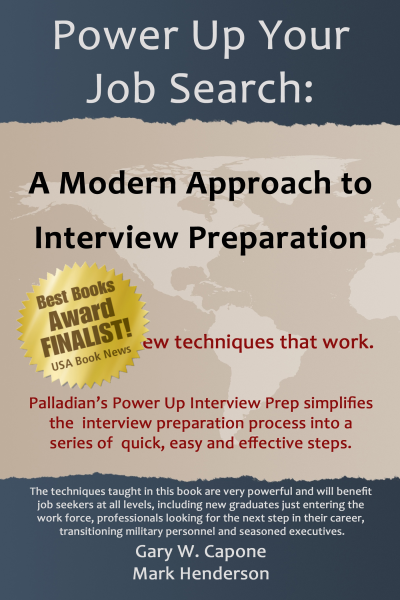
Power Up Your Job Search: A Modern Approach to Interview Preparation, my book teaching interview techniques for job seekers, was named an Award Finalist by USA Book News in the Careers category this week. Since publishing the book back in March, I have heard from numerous job seekers who have used the book to improve their interview skills.
Power Up Your Job Search: A Modern Approach to Interview Preparation, my book teaching interview techniques for job seekers, was named an Award Finalist by USA Book News in the Careers category this week. Since publishing the book back in March, I have heard from numerous job seekers who have used the book to improve their interview skills.
The book is set up as a step-by-step guide teaching how to get ready for an interview. It is ideal for people who want a simple to follow process. We intentionally worked to make the book as short as possible. Each chapter, paragraph and sentence had to add value to stay in the book. We also focused the book on specific skills anyone can learn. This combination makes the instruction in the book quick and easy.
I wish there was a magic bullet that would get people hired. It would make my job teaching interview skills a lot easier. All I would need is a couple minutes with someone and teach them the “secret to interviewing.” There is no secret, and it will never be that easy. To excel in an interview your need to develop your interview skills, prepare thoroughly and practice. That’s why an interview prep book like Power Up Your Job Search is so important. It will teach you the skills you need to adapt to interviewers and questions that blindside you.
If you are getting ready for an interview, get a copy of the book. The job market is too competitive and mediocre interview skills will lead to missed opportunities.
As you write your resume and prepare to interview, you will want show how you contributed to your past employers. Focusing on ways you have cut costs is a good start. Reducing lead times and improving quality are also good to emphasize. These are only starting points for supply chain professionals. Managing risk can be the most important aspect of a supply chain role.
Supply chain professionals face numerous challenges. Sourcing provides some of the most complex obstacles a company will face. Sourcing professionals need to find ways to source high quality products, materials and services at low prices with short lead times and no supply interruptions. All of this must be done in a global economy constantly changing. As a supply chain professional, how you maximize the performance of the supply chain is important, but equally important is minimizing risk.
As you write your resume and prepare to interview, you will want show how you contributed to your past employers. Focusing on ways you have cut costs is a good start. Reducing lead times and improving quality are also good to emphasize. These are only starting points for supply chain professionals. Managing risk can be the most important aspect of a supply chain role.
There are risks in every strategy and tactic a company adopts. Some risks are small. Supply chain risks are often huge. For example, construction firms who utilized Chinese drywall over the last decade face tremendous liabilities as the material has been found contain chemicals that make houses unlivable. Entire subdivisions are being abandoned. There are numerous examples of companies harmed by poor quality materials from suppliers. These risks are significant, but are only the tip of the iceberg.
When sourcing globally, companies face risks from every direction. Currency fluctuations can turn the lowest cost supplier into the highest cost option. Political disputes and striking workers can shut down companies and key transportation routes. Energy price changes can drive up or down transportation costs. Every year, natural disasters, from hurricanes to earthquakes, hit different parts of the world. The more widely spread your supply chain, the more likely you will be affected.
Managing all of these risks is challenging. Risk management was a key theme in one of the supply chain management sessions at the APICS Conference in Toronto I attended. The speaker talked about ways to build in alternatives and options into a supply chain. Developing secondary suppliers and alternate delivery strategies can be essential if your company wants to survive a major supply disruption.
As you write your resume, include examples of your contributions to managing supply chain risk. Often this will take the form of developing additional suppliers. Doubling your supplier base could be an expensive proposition, but it could also be much less costly than a major supply disruption. Your experience with balancing these priorities and the solutions you delivered can help set you apart from other supply chain professionals. Some people just show up. They do the minimal to get by. This usually involves shortcutting to the solution. Showing how you took a more difficult path but set the company up for success no matter what happens is much more valuable.
Risk management is a good topic for a resume, but it may be more suitable for interviewing. On a resume, you need to brief. You may only have a couple lines to devote to each accomplishment. Managing risk can be a complex process not easily condensed. For this reason, your best risk management accomplishment might not help on your resume. Once you get into an interview, though, you will have the opportunity explain what you did more fully and dive into complex accomplishments.
One of the greatest job search challenges people struggle with is identifying a wide range of substantive accomplishments to include on their resume. Accomplishments show what you did. Part of the difficulty lies in how companies measure performance.
One of the greatest job search challenges people struggle with is identifying a wide range of substantive accomplishments to include on their resume. Accomplishments show what you did. Part of the difficulty lies in how companies measure performance.
Every company uses metrics to measure performance. Some companies have comprehensive metric tracking, while others use only a few measures. In either case, the metrics show the performance of an aspect of the company. With a well designed metric system, improving the individual measures will improve the bottom line of the company.
For many people, showing how they directly improved a company’s bottom line can be difficult or impossible. This is where the metrics help. You can show how you improved key areas of the company that are recognized to be drivers of the organization’s success.
For example, in the NFL, how could you assess the performance of a running back? This is made difficult by the variance in the quality of the teams and the different offensive strategies used around the league. Although a running back can have a significant effect on the success of a team, he cannot win alone. So how would you decide who is successful and who isn’t? Football, like all sports, has a number of metrics used to judge a player’s performance. For a running back, this could be yards/game, yards/carry, total yards in a season, touchdowns scored, fumbles and a host of other stats. These metrics measure individual performance and help differentiate runners.
In your career, you should identify the key metrics for your job and track them. Typically, these will be a part of your performance evaluations. Some companies publish their metrics on a regular basis so employees know how the organization is performing. This makes it easier. If your company doesn’t do this, you may have to do a little more work, but you can still show you performance.
There are a tremendous number of metrics. The Supply Chain Council has a benchmarking program with over 400 metrics to choose from. The Performance Management Group is a consulting firm that helps companies improve their metrics. They list 95 metrics they routinely use with clients. For example, PMG lists seven metrics for order fulfillment lead times:
Customer Signature/Authorization to Order Receipt
Order Receipt to Order Entry Complete
Order Entry Complete to Start Manufacture
Start Manufacture to Order Complete Manufacture
Order Complete Manufacture to Customer Receipt of Order
Customer Receipt of Order to Installation Complete
Total Order Fulfillment Lead Time
If you are involved in order fulfillment in any way, you should have had an impact at least a few of these metrics. Show what you did and the effect it had on your resume. This will demonstrate your potential by showing you specific work performance.
As you review metrics and include them in your resume, you need give the reader a clear understanding of the magnitude of the impact. Going back to the NFL, a running back might talk about yards gained in a season. One running back might talk about gaining 1000 yards last season. For people unfamiliar with the NFL, this is meaningless stat. You need some context for the metric to know what it means. Adding one key piece of information, that only 16 players gained 1000 yards in the NFL last year, turns this metric into something significant.
On your resume, it is unlikely you can benchmark your performance against league stats. What you can do is benchmark yourself based on historic performance levels and the goals of the company. For example, if you work in manufacturing, you may want to highlight a fulfillment measure such as Start Manufacture to Order Complete Manufacture. You can show your performance level, perhaps three days. To make this stand out, you need to show what you did and the significance of the measure. For example:
Developed a cellular manufacturing station, a pull production system and a dedicated value stream for the highest volume product class, leading to reduced inventory and shorter manufacturing lead times, including a reduction in the Start Manufacturing to Order Complete Manufacture measure from 6 days to 3 days.
An accomplishment like this shows what the job seeker did and the tangible results they delivered. This type of bullet on a resume will help differentiate the job seeker from other manufacturing professionals. To really get the biggest impact out of this, the job seeker should put an accomplishment like this near the top of the resume. For example, the resume might start like this:
Experienced manufacturing manager with a track record of implementing process improvements and delivering cost savings.
Lean Manufacturing: Developed a cellular manufacturing station, a pull production system and a dedicated value stream for the highest volume product class, leading to reduced inventory and shorter manufacturing lead times, including a reduction in the Start Manufacturing to Order Complete Manufacture measure from 6 days to 3 days.
This presentation will be a good attention getter. On a real resume, I would have a slightly longer summary description before the bullet and would add a couple more bullets with other accomplishments.
Take a look at the metrics used in your company and the metrics common to your industry. These can help you identify the key areas of your company that you impacted. Recognizing the areas where you have had a significant impact is the critical first step.
I had the opportunity to listen to a couple consultants from IBM at the APICS Conference in Toronto. They discussed ways to capture information and make it easier for decision makers to use. The overriding theme of the presentation was transforming a mass of data into an organized, easily accessible store of information. Meeting this challenge can offer job seekers a means of differentiating themselves from their competition.
I had the opportunity to listen to a couple consultants from IBM at the APICS Conference in Toronto. They discussed ways to capture information and make it easier for decision makers to use. The overriding theme of the presentation was transforming a mass of data into an organized, easily accessible store of information. Meeting this challenge can offer job seekers a means of differentiating themselves from their competition.
The guys from IBM quoted two statistics that really stood out. First, they referenced a survey of CEOs where 60% said they need to get better at leveraging information. This is a challenge in every organization, regardless of company size, industry or market position. We live in a world with so much information; it can be difficult or impossible to get a handle on what is really going on.
The second stat related to ability of workers to find the information they need to make decisions. The stat was from a study of workers’ time and found 70% of time is spent searching for information. This means in a company, out of every three people, two of them are looking for information at any point in time. Only one in three is actually acting on the information they find.
These stats point out a major concern in organizations. Capturing data quickly and efficiently, and incorporate that data into decision making are critical capabilities to allow a company to change faster. Speed and flexibility were a major theme of a number of the presentations at the conference. Companies can’t afford to wait a long time to see trends develop and mature. They need to adapt quickly – faster than their competition.
As a job seeker, how is this relevant to your search? Simple, managing and leveraging data is a critical concern for companies, and if you can show how you improved the effectiveness of an employer in this area in the past, you can set yourself apart.
Some people will look at this and assume the change has to be major – implementing a major data management system affecting every aspect of the company. Major technology upgrades are important, but few of us are involved in buying a new ERP system. Despite this, there are a lot of other ways you probably affected information utilization.
Look at the ways you changed the information you required from your team. Did you make any changes to the reporting you required? How did this streamline the process for your team? How did this allow you to make faster and better decisions?
Look at the ways you changed the information you provided others in the organization. How did you improve the speed you were able to distribute information? How did you improve the quality of the information you provided? What did you do to make this information more accessible so others could make better and faster decisions?
These questions point to improvements you may have made in your organizations. Examples of these improvements can show the value you will provide if hired. They are accomplishments that can set you apart from your competition. To present these with the most impact, you should show the end result of the improvement. It’s not enough to just say you improve the efficiency of information gathering activities. How did gathering that data faster allow the organization to do something it couldn’t do before? This improvement could allow for better customer service, better forecasts, improved quality and reduced scrap, faster product development, or a host of other improvements.
Ultimately, you want to show how your efforts made a company more competitive and profitable. The incremental activities towards this goal can be impressive and help you land a job over other candidates with the same or greater experience. The key is showing your contributions and successes. Data management and reporting is critical competency affecting the overall success of a company. Providing examples of your success in this area will help demonstrate your potential.
Demand forecasting is the activity in a company that predicts the level of demand customers will have for a company’s products. This activity usually garners very little attention from outside the company. For most job seekers, demand forecasting is far from their thoughts, and yet, a close look into the metrics of demand forecasting uncovers an important lesson for resume writing and interviewing.
Demand forecasting is the activity in a company that predicts the level of demand customers will have for a company’s products. This activity usually garners very little attention from outside the company. For most job seekers, demand forecasting is far from their thoughts, and yet, a close look into the metrics of demand forecasting uncovers an important lesson for resume writing and interviewing.
Companies are supposed to make what customers want. The challenge is significantly greater than most realize. As we move towards the holiday season, manufacturers and retailers have established their forecasts, and products are moving through the supply chain. Lead times for many products are several months, especially if a product is a big holiday seller. Invariably, we will have a story about the “hot toy” this year that catches all the retailers off guard. They will have far less inventory than they need and manufacturers won’t be able to respond fast enough. By the time we know what is hot; it will be too late to respond by making more.
Although missing sales on one hot product can be a major mistake for a company, consistent demand forecast errors can be even more crippling. Making too much of one product is costly as the inventory sits, or worse, has to be discounted to move. Missing sales on a wide range of products by under forecasting demand will mean lost sales, and in some cases, the loss of major customers.
This was the discussion in one of the sessions I attended at the APICS conference last week. The speaker showed techniques he had used to improve demand forecasting.
Improving demand forecasting can be a significant driver of profitability for a company. Forecasting errors produce waste and lost sales. Any improvement will improve sales and reduce waste. To measure the effectiveness of a company’s demand forecasting, several key performance indicators (KPI) can be used. A few of the KPI’s mentioned were:
MAPE – Mean Absolute Percent Error
ONIF – On Time In Full
SLOB – Slow Moving and Obsolete Inventory
Each of these KPI’s is critical to a business. There are lots of metrics companies can use to measure performance. KPI’s are the critical metrics that do the best job of capturing the performance of the business, and if improved, will drive overall improvement in the overall business.
For individuals in roles developing demand forecasts or contributing to the demand forecast, changes which improve the KPIs can be significant. They are the type of accomplishments that should be highlighted in a resume and discussed in an interview.
Most people, if they include accomplishments, list very general accomplishments and only focus on cost savings. Cutting costs is critical to a business’s long term success, but it is only one element of performance. Discussing other KPIs that drive performance can also make a strong impression on a resume. Discussing the accomplishments in detail, where it is clear what you have accomplished and how you did it, can help set you apart from your peers.
If you are the manager of production planning or demand forecasting, focusing on these measures makes a lot of sense. There are others in the organization who influence forecasting accuracy. The sales department needs to give quality customer forecasts to the planners, otherwise, the planners will be guessing. Marketing needs to provide the planners with their plans for major promotions. The speaker told a great story to illustrate this:
A major car company had forecasted a product mix with a lot of green cars. Manufacturing produced the cars and the new model was rolled out and shipped to dealers. The cars painted green sold below other colors, leading to high inventories. Marketing and sales quickly heard from the dealerships and responded with a large promotion to discount the green cars. Sales went through the roof and the inventory was cleaned out. At the same time, demand planners saw the increasing sales of the green car, but knew nothing of the special promotion. They responded by ramping up production to keep up with demand, flooding the supply chain with even more green cars.
This is an obvious mistake, but it is far from uncommon. Communication within companies can be challenging. If you are in sales or marketing, changing your communications with the planning department can make a significant improvement in the business and affect measures such as MAPE and OTIF. If you have implemented a change like this, you should mention it on your resume. Not only does it show an example of a contribution you have made, it shows a broader understanding of how your role can drive performance of the company.
Bottom Line: Look beyond simple cost savings and revenue generation metrics to show how you impacted the overall performance of an organization. Use the metrics that are true key performance indicators to demonstrate your performance.
As a job seeker, there are hundreds of skills, experiences and accomplishments you can discuss on your resume. Sustainability and environmental initiatives are just one category of priorities you can highlight. So, should you market yourself on the cutting edge of sustainable business practices?
“Going Green,” sustainability and environmentally friendly initiatives continue to gain momentum and are increasingly becoming key priorities for companies. This trend is far from universal. As with every other priority companies face, environmental factors weigh differently from company to company. This was made clear at the APICS Conference in Toronto this week.
The theme of the conference was Global Ability, and sustainability in manufacturing and supply chain roles was a key topic. I had the chance to sit in on several of the educational sessions for sustainable issues. Although many companies are grappling with how to integrate sustainability concerns into their business, several companies showed how they are delivering significant tangible results. Reducing the environmental impact of the business is not a goal at these firms. It is an absolute requirement. Even more important, these companies showed significant improvement.
As a job seeker, there are hundreds of skills, experiences and accomplishments you can discuss on your resume. Sustainability and environmental initiatives are just one category of priorities you can highlight. So, should you market yourself on the cutting edge of sustainable business practices?
Unfortunately, there is no right answer to this question. When you write a resume and market your background, you are trying to align your sales pitch to the priorities of the hiring manager. This is difficult.
There are a couple reasons you may want to highlight your experience with sustainability on your resume. First, job seekers with significant skill and experience with designing and implementing sustainable improvements should show this experience. Hiring managers wanting to improve the sustainability of an organization will value this past experience. Second, job seekers without a lot of experience with sustainability may also benefit from a focus on this area. For many companies, sustainability is still new. Showing an interest and some experience in this area will help demonstrate a closer alignment of your values and interests with those of the company. This by itself won’t get you hired, but may improve your odds.
The biggest challenge is knowing whether to emphasize your environmental experience. If you emphasize this experience, you will have to de-emphasize something else. If sustainability is only a minor concern for a hiring manager, and you decide to emphasize this over a key priority of the hiring manager, you will hurt your chances.
There is only one solution to this dilemma. You need to research the opportunity. Reading the job description is not sufficient. Many job descriptions include standard boilerplate text, listing all of the priorities of the company and the position. Most job descriptions will not be tailored to the specific situation. In fact, the same job description may be used company-wide over a period of many years. Despite this, the demands and requirements of different departments, locations and hiring managers will dictate who is hired. These priorities can vary wildly, while still falling under the broad guidelines of the position.
The research you need to do starts with the company. What are the key priorities of the company? What are they actually doing? It’s easy to write a mission statement with a bunch of goals, but what are the activities to back this up. Companies committed to sustainability as a key priority will show how they are achieving sustainable goals throughout their organization.
Other companies are just starting on the sustainable path. They may have little in the way of tangible results, but consider sustainability a key priority. Additionally, every area of a company will not have the same priorities. New initiatives have to start somewhere and spread through an organization. If the hiring manager is on the cutting edge, their priorities may be different from the company in general.
The more you can drill down on the goals specific to the role you are pursing, the better you will be able to tailor your sales pitch. One technique is to network with current and former employees. If you can find people who have experience working within the organization you are pursuing, you greatly improve your odds.
I’m back from the APICS Conference in Toronto. The event was extremely valuable. If you are not familiar with APICS, the organization provides operations management education, research and professional development. This was the first time I have attended an APICS Conference. I’ve been a member for a long time, but had never made it to conference. I now know what I was missing.
I’m back from the APICS Conference in Toronto. The event was extremely valuable. If you are not familiar with APICS, the organization provides operations management education, research and professional development. This was the first time I have attended an APICS Conference. I’ve been a member for a long time, but had never made it to conference. I now know what I was missing.
Two elements made the conference exceptional. First, the people at the conference are leaders in their fields. They are constantly reinventing manufacturing, operations and supply chain practices, and they are committed to improving not just their companies but their own potential. Second, APICS developed an educational curriculum offering tremendous value.
What stood out to me was the scope of the challenges people were tackling. For example, the theme of the conference was Global Ability. With this theme, people talked about how they were cutting costs and reducing their impact on the environment at the same time. The discussion was not how to balance these priorities. Balancing requires tradeoffs. The discussion focused on ways to achieve both simultaneously without having to hurt one area to help another.
The goals were impressive, but the results were what really stood out. I had the opportunity to hear from people who were succeeding in some of the most challenging situations. For example, one food manufacturer had committed to cutting greenhouse gas emissions, reducing waste and improving profit margins. Several years into their effort, they had made substantial GHG cuts, and they reduced the total waste from a manufacturing plant to less than one dumpster a week. They also demonstrated specific savings from each of the activities they undertook. The result was a company doing significantly more volume, with less overall GHG emissions and waste, and a higher profit margin.
This is a great story and should inspire people to stretch to achieve beyond what appears possible today, but that’s not why I’m telling it. The people who developed the plan, solved the technical problems, led the teams to implement the changes, worked through the details and made this happen, and everyone else involved in the effort delivered substantial success. Do you think there are companies who would like to achieve similar results? Do you think there hiring managers who are tasked with delivering similar results and need help? Absolutely.
With the global theme of the conference, it became clear that the companies around the world face the same challenges. There are differences, but much more was the same. The demand for solutions and the people who can provide them is strong – even as the job market is weak.
To standout in the job market, you need to show how you are exceptional. There are plenty of people who will be average in a role. Hiring managers want people who will deliver results well above average. The key to this is showing what you have done.
Over the next couple weeks, I’m going to focus on operations positions and show how you can differentiate yourself and get hired. Some of the advice will related to resumes and some to interviewing, but most will help across the board in a job search. Although I am focusing on a specific set of careers, the advice holds for anyone. It doesn’t matter what your career field is. Demonstrating your potential through specific examples of your past success is proven technique and very effective in a job search.
So, check back every couple days for the operations management articles. To make it easier, you can sign up for the newsletter and receive all of them, sent twice a month.