A Cover Letter Without Complete Sentences

I read a cover letter today that didn’t have a single complete sentence. Each sentence was written without a subject and many didn’t have a verb. The letter was nothing more than a collection of phrases and buzzwords. I’ve included most of the cover letter below, with identifying information removed.

I read a cover letter today that didn’t have a single complete sentence. Each sentence was written without a subject and many didn’t have a verb. The letter was nothing more than a collection of phrases and buzzwords. I’ve included most of the cover letter below, with identifying information removed.

Twenty years of sales experience with a proven track record and many achievements to mention! Caring and compassion to provide patients with quality products is important. Enjoy running a territory as if it was my own business and exceed at building and maintaining both new and existing relationships to maximize sales growth. Extensive experience calling on key personnel within hospitals and surgery centers.

This letter reads like a resume. It is common to omit the personal pronouns from a resume. This is the accepted style. In fact, the paragraph from the cover letter, with a few changes, could be used as a professional summary at the top of the resume.

A cover letter is different. The goal of a cover letter is to grab the attention of the reader and motivate them to want to read the resume.  To do this, you need to make a connection with reader.  Cover letters are direct, one-on-one communications between a job seeker and a hiring manager. It should be written like a business letter, with a personal, but professional style. The letter above does not fit this mold.

The first sentence of a cover letter should be direct and simple. It should have subject-verb-object structure. I read cover letters routinely that have complicated structures. This just discourages me from reading the entire cover letter. One of the sentence structures I do not like takes a modifying phrase and moves it to the beginning of the sentence. For example, “Possessing 10 years of experience in the widget industry, I have excellent management skills and an ability to drive performance and cut cost.” I would prefer a much more direct format. For example, “I have excellent management skills, gained through 10 years in the widget industry, enabling me to drive performance and cut costs.”

The cover letter I received is nothing more than a collection of phrases. After reading the first line, my impression was confusion. The structure did not fit what I expected. Now, it only took a second or two to figure out the format and structure, and this may seem inconsequential. The problem with this cover letter is that my first reaction was negative and my focus, even if for only a couple seconds, was on structure, not the content of the cover letter.  The end effect was to cause me to question whether I should read the cover letter just a few seconds after looking at it.

It is important to remember that hiring managers screen large numbers of resumes at a time.  Your cover letter and resume may only get a 15 to 30 look before the reader decides to discard it.  This requires a structure and style that can be easily understood.
Historic Context of Our Current Recession

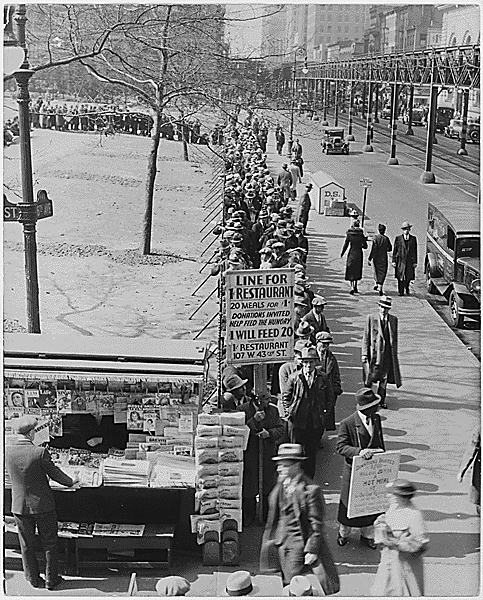
There is a fantastic article in the Wall Street Journal, Obama’s Rhetoric Is the Real ‘Catastrophe,’ comparing our current economic situation to past downturns. The article details several major economic statistics for three time periods, the current situation, the recession of ’81-’82 and the Great Depression.

There is a fantastic article in the Wall Street Journal, comparing our current economic situation to past downturns.  The article details several major economic statistics for three time periods, the current situation, the recession of ’81-’82 and the Great Depression.

The situation today has a lot in common with the situation in 1981, although that recession was a little worse than we are seeing now.  In comparison, the Great Depression is in a category by itself.

One of the statistics from the article that stands out is in regard to unemployment.  The WSJ writes:

“In the last year, the U.S. economy shed 3.4 million jobs. That’s a grim statistic for sure, but represents just 2.2% of the labor force. From November 1981 to October 1982, 2.4 million jobs were lost — fewer in number than today, but the labor force was smaller. So 1981-82 job losses totaled 2.2% of the labor force, the same as now.

Job losses in the Great Depression were of an entirely different magnitude. In 1930, the economy shed 4.8% of the labor force. In 1931, 6.5%. And then in 1932, another 7.1%. Jobs were being lost at double or triple the rate of 2008-09 or 1981-82.”

Our current unemployment would have to triple to approach the worst of the depression.  Last month, we saw a number of positive economic numbers.  I don’t think we’ve turned the corner yet, but we’re not in the death spiral of the early 1930’s either.

It’s important to keep some perspective on the job market when all the news is terrible.  If you are out of work and can’t find a job, it can feel like there is no hope.  Finding a job is tougher today than it was a few years ago – there’s no doubt about that.  It is not impossible, though.

Confidence is a major factor in a job search.  A lack energy and enthusiasm will hurt the impression given in an interview.  It is important to talk about your past successes and demonstrate pride in your accomplishments.  Without energy, enthusiasm and pride, you’re much less likely to succeed.  Self-confidence is often the most difficult aspect of a search to handle.  Losing a job can cause a complete lack of confidence, or worse, mild to severe depression.  Focus on your strengths and past accomplishments.  If you cannot restore your confidence and enthusiasm, seek professional help.


Remember, no matter how bleak the outlook appears, there are still opportunities.  In the late 1920’s and early 1930’s, there were a lot of people that started businesses and began hiring as they grew.  These individuals believed strongly that they could succeed no matter what the economic climate held.  Many failed, but some succeeded.  Below are a few examples of the companies that got their start and fought through the Great Depression successfully:

  • 1929 United Technologies (39th on Fortune 500 List, $54Bil in revenues)
  • 1925 Caterpillar (50th on Fortune 500 List, $45Bil in revenues)
  • 1928 Motorola (65th on the Fortune 500 List, $36Bil in revenues)
  • 1927 Northrup Grumman (76th on the Fortune 500 List, $32Bil in revenues)
  • 1931 Tyson Foods (88th on the Fortune 500 List, $26Bil in revenues)
  • 1930 Publix Super Markets (107th on the Fortune 500 List, $23Bil in revenues)
  • 1926 UAL (124th on the Fortune 500 List, $20Bil in revenues)
  • 1930 Fortune Magazine (Publisher of the Fortune 500 List)

Read the WSJ Article

How Blogs Can Help Your Job Search

Blogging allows job seekers to connect with industry professionals, hiring managers and recruiters. There a number of ways to use blogs to get noticed and find a job.

Blogging allows job seekers to connect with industry professionals, hiring managers and recruiters.  There a number of ways to use blogs to get noticed and find a job.

Write a Blog About Your Search

There are a large number of blogs that focus on the activities of a job seeker in their search.  These blogs give advice and describe the experiences of the job seeker.  As this type of blog proliferates, the effectiveness will decline, but it can still be a benefit.

The advantage of a blog like this is to generate traffic on the hope that someone that visits can help you.  The problem with a blog focused on your search is that the bulk of the traffic will be other job seekers.  Few of these individuals will be in a hiring position.  There are still two benefits to this, though.  First, other job seekers can give advice and tips on where to find leads on jobs.  Second, there are a lot of recruiters and HR professionals that search and visit blogs within their industry.  One of these visitors may be a position to help you. 

I found a blog recently from a student, Germaine Paul, majoring in public relations at Oklahoma State.  The blog details the job search experiences and lessons learned as the student approaches graduation.  I found this blog while surfing stories about career advice.  This is something I do on a regular basis as I'm always looking to stay current on new trends. 

Writing a Blog About Your Industry

You can write a blog about topics within your industry.  This can set you up as a thought leader and attract the interest of hiring authorities in your field.  Many professionals routinely search the web for stories on their industry. 

This effort takes time to be effective.  You cannot post a few articles and generate attention and respect as an industry expert.  To develop a following my take months or years.  If you are currently unemployed, this is a much slower technique than others available.  If you are employed but worried about your job security, starting a blog may be a great tactic to prepare for a possible layoff.  You can build relationships that you can leverage down the road.

Participate in Blog Discussions

One important element of blogging is the dialog between the author and the readers through comments.  Some blogs generate very active discussions, with readers contributing additional thoughts, questions or answers to individual posts.  You can build relationships with others in your field by posting comments on blogs. 

Remember to add value to the blog.  Posting a comment that is poorly written or of little value to the community will make an impression, but not one that will help your search. 

One benefit to participating in a blog is to meet professionals in your field.  You may find contributors that work for companies you are targeting in your job search.  These individuals can become resources and advocates for you.  Consider participating in blogs from industry trade groups, industry thought leaders and trend setting companies. 

If a firm you are targeting has a corporate blog, participate in the discussions there.  The technical experts writing on the blog will notice the active contributors and may assist you in your search.

Mistakes to Avoid

If you are posting comments on a blog, make sure you are presenting a professional image.  It is unlikely that the blog comment form will have spell check.  After you write your comment, copy it over into Word and spell check it.  This will help identify obvious mistakes. 

Provide quality not quantity.  One good comment a week is much better than a dozen poor quality comments.  Don't write comments just to comment.  If you don't have something to contribute, wait for another post.  You want to make an impression of being very thoughtful and experienced in your field.

Interview Tip #3

Interview Tip: Focus on how you will benefit the company, showing your key skills and the value they provide an employer.

Interview Tip: Focus on how you will benefit the company, showing your key skills and the value they provide an employer.

Your potential to grow into a new job is important, but you also need to demonstrate your key skills. Usually, a company will expect you to add value almost immediately after starting. Showing how you can do this will improve the impression you make in an interview.


Resume Tip #3

Resume Tip: Show specific actions you have taken and the results you have achieved on your resume.

Resume Tip: Show specific actions you have taken and the results you have achieved on your resume.

The more specific you are on your resume, the easier it will be for a hiring manager to understand what you did. You may find a less significant accomplishment is better to highlight on your resume than a more significant one because the less significant example can be explained more clearly and concisely.


Resume Examples From Global Sourcing Professionals

Six accomplishments taken from the resumes of global sourcing professionals, along with an assessment of the effectiveness of the accomplishment in selling the candidate’s potential.

Most resumes look alike, with little to differentiate between them.  Job candidates list their past responsibilities and skills. When a company hires a global sourcing professional, all the qualified candidates will have similar backgrounds, having had the same responsibilities and skills.  To stand out, a resume should have specific accomplishments demonstrating the past performance of the job candidate.  The accomplishments provide the sizzle that can get a hiring manager excited.

Below are six accomplishments taken from the resumes of global sourcing professionals. After each example is an assessment of the effectiveness of the accomplishment in selling the candidate’s potential.

Increased profits by an average of 32% after researching and identifying opportunities for volume purchasing with several suppliers, including reviewing fast-moving items and negotiating per-order agreements.

Assessment: This accomplishment is good, but could be better.  Increasing profits by 32% sounds like a good accomplishment, but it isn’t specific enough.  A little more detail regarding the profit margin, total sales and resulting profits would make the accomplishment clearer.  The candidate does a good job of showing how the results were achieved with the description of negotiating volume purchase agreements.

Cut on-hand inventory by 30%, eliminated $50K in costs, and improved cash flow by reducing quantity purchasing and maintaining quantity pricing of packaging materials.

Assessment: This accomplishment provides very specific results.  It is weak on details of how the results were achieved.  Reducing inventories is easy.  What is difficult is reducing inventories while maintaining or improving customer service levels at the same time.  This example does not address the competing priority of customer service, or show how inventories were reduced.

15 years consistently maximizing corporate performance, driving growth, generating revenues, capturing market share, improving profits, and enhancing value in domestic and international markets in the sourcing and procurement industry.

Assessment: In isolation, this sounds good.  Unfortunately, general statements like this are so common that they are often disregarded by hiring managers.  Accomplishments need to be specific and detailed to have the greatest impact.  This accomplishment, despite being very boastful, will do little to differentiate the candidate.

Pioneered a vendor management program incorporating proper vendor administration.  This program enabled accurate measurement of supplier performance, resulting in sustainable cost savings over life of supplier relationships.

Assessment: This accomplishment is ok.  Developing a vendor management program could be a great experience.  The problem with the accomplishment is it doesn’t detail the scope of the program and it doesn’t give any direct results.  The program may have been tested with one small vendor and discontinued or it could have revamped tens of billions of dollars of purchasing.

Implemented change of steel grade for forgings creating $350,000 savings in steel surcharges.

Assessment: This is a good accomplishment.  It shows a specific result.  The activity that led to the result is also clear.  The element that is missing is the role of the candidate in delivering this result.  Did an engineer identify a cheaper material and the buyer just followed the spec?  Or, did the buyer identify the opportunity and take it to engineering and operations for approval?  The first situation isn’t really an accomplishment, while the second could be very impressive.

Consistently ranked in the top quarter of branch offices in Productivity and Cost Per Load.

Assessment: This accomplishment is not very specific, but is still good.  The element  that is noteworthy is the ranking.  Showing a performance measure relative to similar operations can help demonstrate the quality of the performance.

Soft Skills in Global Sourcing Roles

Technical expertise is critical to landing a global sourcing position, but the most successful candidates will demonstrate combination of technical expertise and soft skills.

Technical expertise is critical to landing a global sourcing position. The challenges in sourcing roles require skill and experience to be successful.  These challenges constantly change with new economic and international opportunities and pitfalls.  In this environment, as critical as technical skills are to global sourcing, professional more than just technical skills to be successful.  Roles in global sourcing require a balance of technical expertise and soft skills.

Soft skills form the foundation of a person’s career, driving the ability to apply technical expertise.  The most critical soft skills include:

  • Communications Skills
  • Interpersonal Skills
  • Teamwork
  • Work Ethic/Attitude
  • Organization Skills
  • Flexibility
  • Problem Solving Skills

All of these attributes play a significant role in every career.  In global sourcing, soft skills are critically important.  Sourcing touches almost every functional area of a company, and requires coordinating and supporting these functional areas.  Sourcing also requires extensive interaction with people and organizations outside of the company.

Making the soft skills requirements even more important, global sourcing professionals need to work with international suppliers.  Navigating differences in communication styles and cultural values can be especially challenging.

To be successful in a global sourcing role, an individual needs to be able to apply their technical expertise with their soft skills to reach the desired outcome.  Communicating effectively, by phone, in written correspondence, one-on-one in person and before groups will affect the success of a sourcing professional.  Additionally, being cognizant of culture issues can make or break a vendor relationship.  Adapting to changing market conditions and solving problems are constant challenges and require an individual flexible enough to stay in front of the marketplace.

As you prepare your resume and get ready to interview, include how your soft skills have helped you succeed in the past.  For example, you may write on your resume how you developed a sourcing plan for a new product rollout, and this plan required coordinating sourcing activities in a number of countries.  The technical requirements of such a project could be substantial.  Within the presentation, a little information on soft skills required to pull off this project can help.  Mentioning the communications requirements, the relationship building with new suppliers, the organization and time management challenges and the ability to execute this project so that it supports the efforts of other functional areas are all topics that will help with the overall presentation.

As you move forward in your career search, remember to include your soft skills in your presentation.  A good balance of soft skills and technical expertise can help set you apart.

Behavioral Interview Answers for Sourcing Careers

Answering behavioral interview questions can be challenging due the level of detail required. Behavioral interview questions assess past performance of a job candidate in order to predict how the individual will perform in the future. To impress a hiring manager, answers need to be specific and detailed.

Answering behavioral interview questions can be challenging due the level of detail required.  Behavioral interview questions assess past performance of a job candidate in order to predict how the individual will perform in the future.  To impress a hiring manager, answers need to be specific and detailed.

Behavioral interview questions require the candidate to tell a story.  The questions cannot be answered with a yes or no.  The best answers will give a detailed example that frames the situation, details the actions taken and gives the results of those actions.  Providing an answer with these elements will allow the hiring manager to picture how the candidate performed in the past, leaving a strong, memorable impression.

Many candidates answer in generalities when posed behavioral questions.  This is a big mistake.  General answers do little to differentiate the candidate, leaving an impression that the candidate is average and ordinary.  Instead, a focused example, with clear results, will make the best impact.

Below is a behavioral question followed by two answers.  The first answer is a typical general answer many candidates give.  The second answer provides a detailed example.  Following each answer is an assessment of the effectiveness of the answer.

Example Question: Tell me about a time when a major supplier had significant quality issues with materials shipped to you.

General Answer: Managing supplier quality is a constant challenge.  We have supplier scorecards we use to track quality, and perform quality audits on a routine basis.  When a major quality problem occurs, we contact the vendor and work to the resolve the problem quickly.  This includes traveling to the vendor or having the vendor travel to our facility to work on resolving the problem.

General Answer Assessment: This answer fails to answer the question.  It describes how quality problems are dealt with, but does not provide a specific example.  Many job seekers make this mistake with behavioral questions.  For questions about routine activities, the candidate discusses activity in generalities. Answers like this will not be remembered and will not help sell the candidate to the hiring manager.

Specific Example Answer: Managing supplier quality is a constant challenge.  Usually, we can resolve quality issues quickly, without affecting production schedules.  One situation I encountered proved to be especially challenging.  We had a key raw material with very high quality specifications.  Any deviation from these specs made it impossible for us to produce a product to our customer’s requirements.  The key vendor we used was located outside of New Orleans.  After Katrina hit, it was a major priority to get them up and running.  Within a week of the storm hitting, I relocated to their location to monitor the plant restart.  The storm damaged some key equipment, leading to fluctuations in quality.  It was clear that fixing their problems was not going to happen overnight.  I traveled to potential vendors in six countries over a two week period and found two suppliers that could provide this key raw material within our specifications.  We expedited shipment and only lost eight production days due to the supply interruption.  Today, we divide our purchasing between our original supplier and the two new suppliers, mitigating any risk we might face from a situation like this in the future.

Specific Example Answer Assessment: This answer is specific and addresses the question directly.  The example is easy to follow and demonstrates exactly what the job candidate did to solve the problem.  In addition, the answer discusses how the supply interruption led to sourcing changes (adding additional suppliers) to ensure that this situation is never repeated.

When preparing for a behavioral interview, develop a number of stories from your experience you can tell.  This will allow you to adapt to a wide range of questions.  Providing specific examples will also make your answers more memorable.


Get our book on behavioral interviewing.

Other Great Books to help you prepare for Behavioral Interviews:

Behavioral Interview Questions for Sourcing Jobs

Sourcing manages the process a company uses to find and acquire materials with the supply chain function. A selection of behavioral interview questions targeted to activities and challenges within the sourcing field is provided.

Behavioral interviews focus on assessing the past performance of a job candidate.  The questions explore specific situations and activities the job seeker is likely to have experienced.  This makes behavioral interviewing a good tool in selecting sourcing professionals.

Sourcing manages the process a company uses to find and acquire materials within the supply chain function. The complexity of sourcing, especially from international suppliers, opens the door to a very wide range of interview questions. Below is a selection of behavioral interview questions that can help prepare for a supply chain interview:

  • Tell me about a time when you switched from a domestic to an international supplier for a major raw material.

  • Tell me about the greatest sourcing challenge you have faced in your career.

  • Tell me about the most difficult vendor relationship you have managed.

  • Tell me about a time when you made a poor decision in selecting vendors.

  • Tell me about a time when you assessed the risk of a supply interruption from a source of critical purchased materials.

  • Tell me about a time when you reduced the landed cost of a material by sourcing from a supplier with a higher unit cost.

  • Tell me about a time when a major supplier had significant quality issues with materials shipped to you.

  • Tell me about a time when a cultural issue between you and a vendor or potential vendor led to a collapse of the relationship.

  • Tell me about a time when you reduced raw material inventory levels without affecting customer service.

  • Tell me about a time when you utilized intermodal transportation for a key material.

  • Tell me about a time when you utilized a freight forwarder.

  • Tell me about a time when you utilized a 3PL.

  • Tell me about a time when you conducted an audit of a potential vendor overseas.

  • Tell me about a time when you had to overcome significant security concerns in an international market.

  • Tell me about a time when you replaced a preferred vendor due to changes in exchange rates.

  • Tell me about a time when miscommunication with a vendor led a conflict with the vendor.

  • Tell me about a time when you utilized a international procurement office to identify and manage vendors.

These questions cover a variety of topics related to supply chain and sourcing roles. With the thousands of potential interview questions, it is unlikely you will see many from this list in each interview. Despite this, preparing for these questions will help your interview performance.

Almost all companies will have challenges with some of the topics in the list. If you are prepared to discuss these challenges, few questions about your sourcing experience will be difficult.


Get our book on behavioral interviewing.

Other Great Books to help you prepare for Behavioral Interviews:

Resume Writing for Sourcing Careers

Resume writing for supply chain professionals, particularly in sourcing careers, requires addressing specific challenges and goals that are important to the target employer. By highlighting these topics in your resume, you can standout from your competition.

Resume writing for supply chain professionals, particularly in sourcing careers, requires addressing specific challenges and goals that are important to the target employer.  By highlighting these topics in your resume, you can standout from your competition.

Sourcing careers manage the identification of suppliers, the purchasing of materials, and the logistics of purchased materials and components. In our modern global economy, sourcing provides the foundation of many companies. More than any other function, sourcing can change the financial condition and competitiveness of a company quickly.

A number of companies have capitalized on their sourcing expertise to build powerful competitive advantages over their competition. Wal-mart and Dell are both known for the efficiency of their supply chain operations. Slight improvements to the sourcing function can dramatically affect the bottom line performance of a company.

The significance of sourcing roles to the success of an organization makes finding exceptional talent in the sourcing field a critical component of a company’s success. During the hiring process, most companies will have specific goals and expectations for the position. To be successful, a job seeker needs to demonstrate an ability to make an impact on these specific goals.

Many job seekers find it difficult to identify the goals of the company and the hiring manager. You may be able to research and determine the priorities, but often this won’t be possible. Instead, you need to address the major challenges that are most likely to be priorities based on the industry and company.

There are a number challenges that are likely to be important within the materials field, including:

  • Vendor Identification

  • Vendor Qualification

  • Quality Monitoring

  • Legal and Contract Concerns

  • Transportation

  • Customs

  • Scheduling

  • Inventory

  • Supply Interruptions

  • Issues With Political or Economic Instability

This is a partial list but can give you a starting point for marketing your background. On your resume, you should mention a variety to challenges and goals. It is important to include more than just a list of keywords. Provide details of your experience and accomplishments for each area of expertise. You may choose to emphasize a selection of skills, but try to mention most of them in your resume.

One way to highlight your sourcing skills it to start your resume with an executive summary.  The executive summary should include two or three of your most significant accomplishments. This will draw attention to your strongest skills and accomplishments, highlighting a few key elements of your experience. You can then work the remaining elements you want to mention into your resume under your work experience section.

If you show significant experience in the sourcing arena, and mention the key topics that a hiring manager is seeking, you are likely to get a phone screen. You do not need to guess the top priority of the hiring manager and emphasize this in your executive summary.  As long as you mention the topic and show significant sourcing expertise, you should generate sufficient interest to motivate the hiring manager to want to learn more.  If you do not focus on a topic critical to the hiring manager, the phone screen will usually explore this topic in detail.

The list of competencies above omits one very common topic. In fact, it is by far the most common topic of accomplishment, and a critical element you need to cover in your resume. The omitted element is your experience with reducing costs. Reducing raw material and transportation costs are one of the biggest opportunities most companies have. Cost reductions through better sourcing can offer the best ROI. An investment of time and some travel costs for a sourcing professional can often yield millions of dollars in savings.

There’s an important reason why I omitted cost reductions from the list above. The reduction of cost is the result of an activity. It is not the core activity. For example, picture a sourcing professional that includes this accomplishment on his resume: “reduced the purchasing costs of a key raw material by $3 million.” This is a good accomplishment but doesn’t say anything about how the individual achieved this result. Another candidate, with a similar background, lists the same accomplishment, but with additional key details: “Identified two dozen new potential vendors for a key raw material. Assessed and qualified three to be suppliers. Negotiated international contracts with two of these sources, resulting in $2 million in savings from lower purchase costs and $1 million in transportation savings.”

These could be the same accomplishment, but the second presentation is much more specific and makes a much stronger impact. If the hiring manager is focused on identifying new sources, assessing potential sources or reducing transportation costs, this accomplishment should peak their interest.

Show what you did with the results you achieved. When we assessed resumes in our resume benchmarking survey, we found nearly half of the resumes didn’t list any accomplishments. Many of the resumes that did list accomplishments, only included cost savings numbers – accomplishments similar to the first example provided above. If you give a detailed presentation of what you did, how you did it and what the results were, your resume will standout for the vast majority of your competition and your chances of landing an interview will be much higher.

Need specific resume writing advice tailored to Supply Chain Careers?  Get our book, Resume Writing for Manufacturing Careers.  It is packed with examples and advice of production management, scheduling, purchasing, logistics and transportation.