Resume of a New MBA

I received a resume from a student about to graduate with an MBA. The candidate went straight from her undergraduate to graduate school. During both programs, she held a series of entry level retail jobs.

I received a resume from a student about to graduate with an MBA.  The candidate went straight from her undergraduate to graduate school.  During both programs, she held a series of entry level retail jobs. 

This career progression shows a good commitment and work ethic.  The problem with the resume is the order of the information.  It emphasizes the work history and not the education.  The job seeker is not going to land the type of job she is pursuing based on her work experience.  She’s going to get hired because of her education.  This needs to be emphasized as the main selling point.

Below is the resume structure:

Summary Statement (19 words, does not mention the education, focused on the work experience)

Experience

  • Job 1 (127 words)
  • Job 2 (75 words)
  • Job 3 (70 words)

Education

  • Master’s Degree
  • Bachelor’s Degree

Skills

The entire resume had 387 words, so the listing of the three jobs represents 70% of the text.  It’s also at the top of the resume.  There’s a good chance a hiring manager receiving this resume will read the summary statement, skim the work experience and discard the candidate.  This is unfortunate, because the job seeker has some great skills and a very good education. 

A better way to organize this resume would be to focus on the education and skills of the job seeker.  A hiring manager is going to be impressed with the potential of the job seeker, not the jobs she has held.  The jobs help show her work ethic, but this is just one attribute.  The experience should be placed in a supporting role, not the lead.

I would reorganize this resume into the following order:

Summary Statement (emphasizing the education and key skills)

Education

  • Master’s Degree
  • Bachelor’s Degree

Skills

Experience

  • Job 1 (127 words)

  • Job 2 (75 words)
  • Job 3 (70 words)

This structure leads off with the candidate’s strengths.  The content didn’t change (except for the summary statement). Only the organization of the content changed.  The other option I considered was switching the skills and education.  As impressive as the education is, the job seeker possesses some great skills that might be more impressive for some careers.  In this case, leading off with the skills would be better than starting with the education.
How to Present a String of Short Term Jobs on a Resume

Some industries naturally foster high mobility, while others have undergone major turmoil causing businesses to come and go quickly. Regardless of the cause, if you held a number of short term jobs, presenting your work history can be a challenge.

Some industries naturally foster high mobility, while others have undergone major turmoil causing businesses to come and go quickly.  Regardless of the cause, if you held a number of short term jobs, presenting your work history can be a challenge. 

The challenge comes balancing two priorities.  First, you want to highlight your current experience and skills.  Second, you want to emphasize your stability and reliability.  Putting the jobs at the top of your resume satisfies the first priority but also highlights the lack of stability.

There are a couple of solutions.  First, you can choose a functional or hybrid structure.  In these structures, you focus the resume on your skills.  Near the top of your resume, you list the key skills you want to promote and provide a detailed description of your experience and accomplishments with each skill.  This can be very effective in technical careers.

Your goal with a functional or hybrid structure is not to hide your work history.  You still need to show where you worked with start and end dates.  The goal is to craft a sales presentation for your background focused on your strengths.  Trying to hide your work history will backfire.  At some point, a hiring manager is going to ask about your work history.  If you have created a false perception, when the hiring manager learns the truth, it will cast doubt on everything else in your background.

A second option to consider is listing your work experience and explaining the reasons for leaving each job.  If you have worked for a series of companies that all closed or downsized, explaining this situation can help.  It explains to the hiring manager why you didn’t stay where you were.  You should keep this brief, only a few words.  Provide just enough for the hiring manager to understand the cause. 

Choosing which option to take will depend on the elements you want to emphasize.  You may want to highlight one or two employers because of the reputation of the companies.  This requires a chronological resume with your work history near the top of your resume.  If you want to emphasize technical skills, consider the functional structure.  If you choose the functional structure, this doesn’t preclude you from also explaining why you left each position.  You can do both. 

Cover Letter Credibility

The cover letter l read this morning contained several statements designed to make a personal connection with a hiring manager, but failed dismally. The cover letter was too wordy and faked an interest in an employer.

The cover letter l read this morning contained several statements designed to make a personal connection with a hiring manager, but failed dismally.  The cover letter was too wordy and faked an interest in an employer.

How can I be so sure the interest in the employer is faked?  Easily, the cover letter and resume were posted online.  They were not sent to a specific company.  There is no way for the job seeker to know who is going to read his resume.  Below is how he started his cover letter:

I am looking for a dynamic and challenging position where I can utilize my leadership, operations, and human resources expertise.   I am familiar with your organization and am extremely interested in working for a company of this caliber. 

Making the claim of being familiar with the organization, when the job seeker has no idea who is going to read the resume hurts the overall impression and credibility of the job seeker.  My reaction is to consider this a bunch of BS and to expect the rest of the cover letter and the resume to more of the same.  The job seeker now has an uphill battle to win me over.

The cover letter would have been much stronger if it had skipped this first paragraph entirely.  The next paragraph focused on the candidate’s skills and abilities.  It’s not perfect, but makes a fair impression and would be fine without the intro in the first paragraph. 

Remember your audience, a resume screener or hiring manager, will be skeptical when reading your resume and cover letter.  They know each job seeker tries to create the best sales pitch.  Part of the assessment is looking for claims that are not credible and exaggerations that overly inflate the candidate’s experience.  You do not want to hurt your credibility by including information that is obviously untrue. Your resume may only get a 15 to 30 second look initially.  You have a lot of competition and it is easy for a hiring manager to reject you and move on to the next resume.  Don’t give them a reason at the start to reject you.

Improving a Resume Summary Section

The resume I read this morning started with an executive summary providing an overview of the job seeker. The summary focused on generalizations while the resume contained a number of specific accomplishments and experiences. The result was a summary that did little to help the overall impression.

The resume I read this morning started with an executive summary providing an overview of the job seeker.  The summary focused on generalizations while the resume contained a number of specific accomplishments and experiences.  The result was a summary that did little to help the overall impression.

Below are the first few lines of the executive summary:

Veteran Military Officer with extensive aerospace industry experience. Dynamic Industry Leader. Technically astute. Customer focused. Results oriented. Employs decisive, analytical approach to problem solving.

This summary lists some great attributes, but the buzzwords are so overused they make no impression.  Everyone says the same thing.  A much better approach is to provide a few attributes and back them up with specific accomplishments.

This individual managed a number of multi-million dollar projects producing significant enhancements to the military capability of various aircraft weapons systems and cost reductions to the military.  These accomplishments are buried within the text of the resume.  A hiring manager scanning the resume quickly is likely to read only a small portion of the text and may miss some or all of the accomplishments.  For this reason, the accomplishments making the best impression should be listed at the top of the resume.

I would rewrite the summary section in this form:

Veteran Military Officer with extensive aerospace industry experience.

  • Technically astute – <insert the description of a successful technically challenging project>
  • Customer focused – <insert the description of a project requiring a high level of customer service>
  • Results oriented – <insert a successful project with significant cost savings>
  • Employs decisive, analytical approach to problem solving – <insert a project requiring complex problem solving skills>

The job seeker has examples in his resume for each of these bullets.  All he needs to do is copy and paste them at the top.  This will make a much stronger impression and ensure a hiring manager will see his strongest accomplishments first.

When to Arrive at an Interview

When going to a face to face interview, many job seekers wonder when the best time to arrive is. Should you get there exactly when the interview is scheduled? Should you arrive early, and if so, how early? Will you kill your chance of getting hired if you are late?

When going to a face to face interview, many job seekers wonder when the best time to arrive is.  Should you get there exactly when the interview is scheduled?  Should you arrive early, and if so, how early?  Will you kill your chance of getting hired if you are late?

Unfortunately, there is no single answer to these questions that will hold in every situation.  There are some guidelines you can follow to maximize your chance of success.

First, you should arrive at an interview early.  The further you must travel, the more time you need to add to your trip.  In major cities with significant traffic congestion, you also need to plan around delays.  Ideally, you want to arrive at the company fifteen or twenty minutes early.  This will give a little leeway in case you are delayed. 

If you arrive more than 15 minutes early, you should wait to enter the facility.  Walking in too early can start the interview on the wrong foot.  The hiring manager scheduled the interview for specific time and will expect you to arrive then.  If you walk in earlier, the hiring manager will have to do one of two things.  He might feel he should adjust his schedule to start the interview early, or he will make you wait in a lobby of conference.  If you have any anxiety about interviewing, waiting without anything do can raise the tension much higher.

A better strategy is to arrive at the company’s location and wait in your car until five minutes before the interview.  This will give you the opportunity to review your interview prep notes.  If you are significantly early, driving around the area can help learn about the region (especially important if you are considering relocating).  With more time, finding a restaurant where you can sit and wait.

If you are early, you just need to kill some time.  But what if you’re late?  There are interviewers reject any candidates that are late.  Most interviewers will take into account the circumstances.  If you are running late and call ahead to let the interviewer know you are going to be late, you should be ok with most interviewers.  Once you are late, there’s not much you can do. 

Getting stressed out because you are late can destroy any chance you have left.  You will not be able to change the interviewer’s impression.  Apologize and go forward confidently and professionally.

Supply Chain Resume Review

The resume and cover letter I read this morning contained a number of mistakes I routinely see. The candidate is a supply chain professional from one of the biggest and best known manufacturing companies.

The resume and cover letter I read this morning contained a number of mistakes I routinely see.  The candidate is a supply chain professional from one of the biggest and best known manufacturing companies.

The cover letter was long, a full page, but it had very little substance.  The bulk of the cover letter was content straight from the resume.  In fact, there is nothing in the cover letter that isn’t also in the resume.  In addition to the substance of the cover, there was a lot of hype.  For example, the sentence below is taken from the middle of the cover letter:

I am an interpersonally-skilled team leader with a rapid advancement history and a unique blend of analytical and communication skills.

This sentence will do little to impress a hiring manager.  The rapid advancement history is a plus, but the rest of the sentence is just hype.  Even worse, the value of the characteristics isn’t clear.  I doubt a hiring manager has ever said they need a person that is an “interpersonally-skill team leader” and has “unique blend of analytical and communication skills.” The hiring manager is focused on finding someone that can achieve specific results.  Nothing in the cover letter references specific results and accomplishments.

This omission is emphasized in the resume.  The resume starts with a Professional Summary.  The first line is “Results-driven Logistics & Planning Manager with global supply chain management…”  How can a person be results-driven, but fail to list a single accomplishment?  It doesn’t make a good impression.

Another problem with resume and cover letter relates to the career progression of the job seeker.  This individual spent more than ten years with his last employer.  Then, more than six months ago, he stopped working there.  There is no explanation why.  There are many candidates who have been laid off due to a downsizing or facility closure.  Despite this, a hiring manager is unlikely to assume the candidate way laid off.  It is more likely the hiring manager will assume the candidate was fired.

If the job seeker was fired, this isn’t a deal breaker.  He was with the same company for more than ten years and received a couple of promotions in the process.  Most companies will look past a termination, if the candidate can explain why the problems leading to the termination won’t occur in the future.

Recommendations:

  • A Short and Concise Cover Letter:  The cover letter needs to be cut down to under 100 words.  At more than 300 words, it isn’t going to get read.
  • Include Accomplishments in the Cover Letter:  The cover letter needs to have some substance.  Adding a couple of  accomplishments demonstrating past successes can make a very good impression.
  • Add Accomplishments to the Resume:  In a 10+ year career, with a couple of promotions, the job seeker must have done something right.  Include a few accomplishments on the resume.
  • Explain the Gap in Employment:  The job seeker has been out of work for six months with no explanation why they left their last position.  Including a statement in the cover letter why the job seeker is unemployed can answer what is likely to be the top question by a hiring manager.

Newly published in 2010:  Get the best book for Manufacturing Resumes

Resume Writing for Manufacturing Careers - Front Cover

Interviewing with a Former Boss or Coworker

If you network well, there’s a good chance you will eventually interview with a former boss or coworker. This can feel awkward. The interviewer has firsthand knowledge of many of the experiences and accomplishments from your background. They also know about your failures and weaknesses. Preparing for an interview like this can be difficult.

If you network well, there’s a good chance you will eventually interview with a former boss or coworker.  This can feel awkward.  The interviewer has firsthand knowledge of many of the experiences and accomplishments from your background.  They also know about your failures and weaknesses.  Preparing for an interview like this can be difficult. 

When you prepare for an interview with someone that you know well, you need to approach the interview just like any other interview.  Prepare examples of your experience from both the times you worked with them, and when you worked apart.  Don’t assume the person will remember all of your accomplishments from the time you worked together.  It is likely, they have forgotten many of the details. 

The experiences you gained after working together are also important.  You should provide a clear picture of what you have been doing, and what you have accomplished.  Discussing your recent experiences provides an opportunity to show how you have learned and grown professionally.  The interviewer will know your weaknesses.  Showing you recognized these weaknesses, worked to improve on them, and succeeded in developing in these areas can be very impressive in an interview.

You can expect some of the interview to be very conversational, with the two of you reminiscing.  This is good but don’t forget you’re in an interview.  Focus on listening and answering the questions asked. 

When you interview with a former coworker, you have one big benefit: you are a known entity.  Hiring managers want to make a great hire, but often are more worried about avoiding a bad hire.  Knowing a person will be able to meet expectations, even if they aren’t a super star, can be the tipping point in a hiring decision. 

There is one question you can ask that could improve your chances: “What about this position will be more difficult for me in comparison to the job where we worked together?”  The goal of this question is to uncover any reason the interviewer might reject you.  You may not be able to overcome this, but at least you will have the chance to address it. 

If you ask this question, be prepared for some criticism.  You’re asking the interviewer to tell you why they think you won’t succeed.  If you get defensive or argumentative, you will almost guarantee that you will be rejected. 

There’s a chance the objection will be something you can’t overcome.  For example, the hiring manager wants a technical skill you don’t have.  In this situation, there’s only one thing you can do.  You need to express your commitment to learn the new skill quickly.

The other scenario involves and objection in an area where you have gained experience and skills since working with the interviewer.  The interviewer will picture you exactly as you were when you last worked together.  Your challenge is changing the picture.  Show the new experiences and accomplishments you have had.  If you do this effectively, you will show how you are more capable than in the past.

Job Search Webinar

“Job Search Basics” will provide specific advice for how to manager a job search. I’m going to review some of the websites and tools that are extremely helpful. I’ll also share tips for how to use these tools to get results.

I finished setting up the third webinar I am planning next week.

“Job Search Basics” will provide specific advice for how to manager a job search.  I’m going to review some of the websites and tools that are extremely helpful.  I’ll also share tips for how to use these tools to get results.

The webinar will review:

  • Tools to find job opportunities
  • Tools to help you manage the search process
  • Tools to research jobs, companies and opportunities
  • Tools to improve your networking

This webinar is best suited for job seekers with some familiarity of online resources but questions about what other resources exists.  If you have used the big job boards and want to know what else is out there, I’ll point you in the right direction.

Join me on Friday July 10th at 11AM EDT for this event!  Register for Job Search Basics

Update:  I now do webinars for APICS.  Check out the career resources APICS offers members.

New Job Interview Prep Webinar

On Wednesday, I’m going to conduct a webinar teaching job interview techniques. The “Job Interview Basics” class will be held on Wednesday July 8th at 11AM EDT. The session is free and I invite any job seeker interested in improving their interview skills to attend.

On Wednesday, I’m going to conduct a webinar teaching job interview techniques.  The “Job Interview Basics” class will be held on Wednesday July 8th at 11AM EDT.  The session is free and I invite any job seeker interested in improving their interview skills to attend.

The “Job Interview Basics” webinar will teach job seekers the how to sell their experience, accomplishments and potential in a job interview.  This one-hour session will cover the following topics:

  • The interviewer’s perspective
  • The types of interviews and the styles of interviewers
  • The structure of an interview
  • How to prepare an answer for the most common interview question, “Tell Me About Yourself”
  • A technique to prepare for almost any question (STARL)
  • How to research a company
  • What questions to ask 

The webinar incorporates many of the techniques taught in my book, Power Up Your Job Search: A Modern Approach to Interview Preparation.


Update:  I now do webinars for APICS.  Check out the APICS career portal for more information.

Resume Layout – Use Tabs Not Spaces

Many people put a lot of time into spacing out their resume so it looks perfect. Then, they send it to a hiring manager and the formatting changes completely. Often, the problem is caused by the font the person used to write the resume. You can’t guarantee the reader is going to see your resume with the same font you used.

Many people put a lot of time into spacing out their resume so it looks perfect.  Then, they send it to a hiring manager and the formatting changes completely.  Often, the problem is caused by the font the person used to write the resume.  You can’t guarantee the reader is going to see your resume with the same font you used.

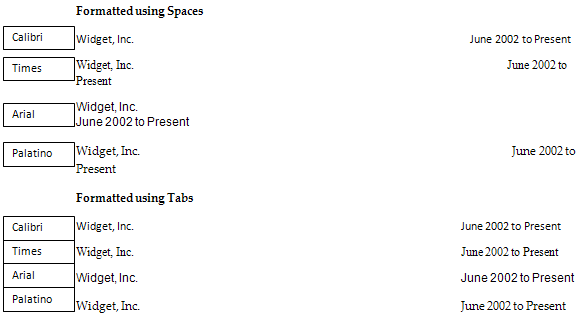
Below are eight examples of one line of textthe same resume text.  The first four examples are formatted using spaces and the second four are spaced with tabs.

Even though the different fonts are significantly different sizes (even though the text size is 11pt for all of the choices), the text formatted with Tabs still lines up.

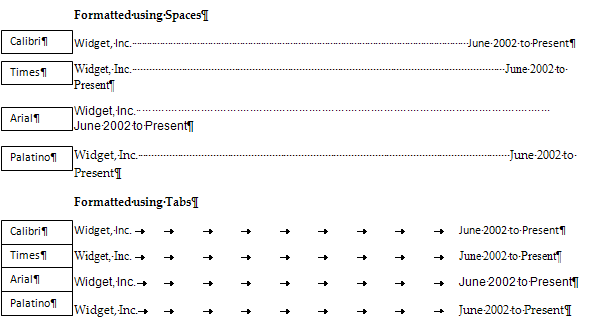
One of the challenges I find job seekers run into is knowing how their text is spaced.  There is a tool in most word processors that makes this easy.  The button with a backwards “P” will display all of the formatting markers.  This will show you have text is spaced on your resume.  Below is the same text from above with the markers displayed.  A dot is a space and an arrow is a tab.

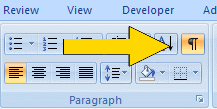
In case you have trouble finding the button that shows the markers, it looks like this:

Just click it once to turn this feature on, and click it again to see your resume without these formatting markers.

Our book on Resume Writing provides numerous formatting recommendations.  The examples use resumes from manufacturing careers, but the techniques are applicable to any career field.  Get our book and learn resume formatting techniques.