Posts Tagged ‘resume advice’

How to Present a String of Short Term Jobs on a Resume

Some industries naturally foster high mobility, while others have undergone major turmoil causing businesses to come and go quickly.  Regardless of the cause, if you held a number of short term jobs, presenting your work history can be a challenge. 

The challenge comes balancing two priorities.  First, you want to highlight your current experience and skills.  Second, you want to emphasize your stability and reliability.  Putting the jobs at the top of your resume satisfies the first priority but also highlights the lack of stability.

There are a couple of solutions.  First, you can choose a functional or hybrid structure.  In these structures, you focus the resume on your skills.  Near the top of your resume, you list the key skills you want to promote and provide a detailed description of your experience and accomplishments with each skill.  This can be very effective in technical careers.

Your goal with a functional or hybrid structure is not to hide your work history.  You still need to show where you worked with start and end dates.  The goal is to craft a sales presentation for your background focused on your strengths.  Trying to hide your work history will backfire.  At some point, a hiring manager is going to ask about your work history.  If you have created a false perception, when the hiring manager learns the truth, it will cast doubt on everything else in your background.

A second option to consider is listing your work experience and explaining the reasons for leaving each job.  If you have worked for a series of companies that all closed or downsized, explaining this situation can help.  It explains to the hiring manager why you didn’t stay where you were.  You should keep this brief, only a few words.  Provide just enough for the hiring manager to understand the cause. 

Choosing which option to take will depend on the elements you want to emphasize.  You may want to highlight one or two employers because of the reputation of the companies.  This requires a chronological resume with your work history near the top of your resume.  If you want to emphasize technical skills, consider the functional structure.  If you choose the functional structure, this doesn’t preclude you from also explaining why you left each position.  You can do both. 

A Resume to Guarantee a Failed Job Search

A resume I received recently virtually guaranteed the job seeker will not land a job.  I see a lot of bad resumes.  Most have significant opportunities for improvement.  Despite this, the resume I read stood out as a disaster. 

The resume failed to include anything to demonstrate the ability of the job seeker to succeed in the field he is pursuing.  Even more troubling, there was almost nothing on the resume to indicate what the job seeker was seeking. 

The job seeker had held several entry level jobs in a variety of industries.  Each field involved vastly different skills.  The job seeker packed the first page of his resume with all of these skills.  There were dozens. 

This is common.  Many job seekers try to include every skill, just in case one of the skills is important to a hiring manager.  The problem with this strategy is how a hiring manager assesses a resume.  A hiring manager will look for the skills the job seeker is strongest with first.  If there is no differentiation between the skills, the hiring manager won’t be able to determine, which are especially strong and, which are weak.  All of the skills get discounted to a low average proficiency level.

The skills listed on the resume had little to nothing to do with the field the job seeker was pursuing.  The job seeker was interested in changing career fields.  There is no way I could have known this from just the resume.  If I had a position that fit this person’s goals, I would never have thought to consider him for it.  It’s almost impossible to land a job if your resume won’t get an employer to even consider you for the right position.  Unfortunately, this mistake is common.

What You Should Do

  1. Prioritize Your Skills – What are your three most marketable skills?  These are skills that relate directly to the position you are pursuing.  They are also skills where your skill level is high.
  2. Review the Top of Your Resume – Read the top half of the first page of your resume.  Are you three most marketable skills mentioned prominently in this area?  How many other skills are mentioned?  Do you have any accomplishments showing your ability to contribute using your skills?
  3. Emphasize Your Marketable Skills – List your top three skills in the first couple lines of your resume.  You want these skills to be so obvious a hiring manager will never miss them.  Move your other skills down.  Your less marketable skills may still be beneficial on your resume but should be placed throughout the body of your resume or listed at the bottom.
  4. Add Accomplishments – Make sure you include at least one accomplishment where you used a skill to make a specific contribution to a company.

If you follow these four steps, you will give yourself a chance.  The steps are just guidelines, though.  You may decide to emphasize only two key skills or may settle on four or five closely related skills.  The important thing is to focus your resume on the marketable details from your background that will get attention.

Eliminate “Responsible for” From Your Resume

Job seekers overuse the phrase “Responsible for” on their resumes.  It is an easy phrase to use.  Just put “responsible for” at the start of a bullet and describe some aspect of the job.

Writing a resume like this will not make a good impression.  A resume I read today illustrates this very well.  The resume is from an insurance agent, but it makes it hard to determine whether the agent was successful.  The resume and cover letter contained details that fail to create a clear picture of the job seeker’s performance.

A resume should provide a clear statement of the success of the job seeker.  Instead, it lists a number of responsibilities and sales goals.  The resume never comes right out and says whether the job seeker achieved the goals.  Below are the bullets under the most recent job listed:

  • Responsible for sales, management, marketing and service of commercial, life, group, LTC, and voluntary benefit insurance products, as well as pension plans
  • Directly responsible for increasing the territory book of commercial business from $#.# million to $#.# million over a # year period.
  • Responsible for increasing group life customer base from 0 to ## current groups.
  • Responsible for increasing LTC book from $0 to $###,000.
  • Responsible for increasing territory pension assets from $#.# million to over $#.# million in just over # years.
  • Directly responsible for increasing current commercial client base from ## accounts to ## accounts.
  • Responsible for increasing life insurance book from $##,000 to $###,000 over # years.

There are two ways to read this.  You can assume the statements are a list of sales goals the agent was responsible for hitting, or you can assume the statements detail the specific results the agent achieved.  If they are goals, there is nothing to indicate the agent was successful in achieving them.  When a hiring manager is screening hundreds of resumes, and only spends a very short time skimming each, you can count on the hiring manager to be very skeptical.  Most will assume the job seeker was unsuccessful if the job seeker does not specifically detail the successes.

Further hurting the presentation, the job seeker uses two different phrases, “responsible for” and “directly responsible for” in the bullets.  There’s a chance the job seeker is just trying to vary the structure and reduce the repetitiveness of the resume.  It is also possible the job seeker is showing the difference between individual and group goals or accomplishments.

Recommendations

The changes to correct this are easy to implement.  If the bullets detail specific accomplishments and not sales goals, each bullet (except the first) should be changed to eliminate the “responsible for.”  Below are the revised bullets:

  • Responsible for sales, management, marketing and service of commercial, life, group, LTC, and voluntary benefit insurance products, as well as pension plans
  • Increased the territory book of commercial business from $#.# million to $#.# million over a # year period.
  • Developed the group life customer base from 0 to ## current groups.
  • Developed the LTC book from $0 to $###,000.
  • Increased the territory pension assets from $#.# million to over $#.# million in just over # years.
  • Grew the current commercial client base from ## accounts to ## accounts.
  • Increased the life insurance book from $##,000 to $###,000 over # years.

This reads much better and provides a stronger impact.  The contributions of the job seeker are clear after these minor changes.

If the job seeker did not achieve these goals, rewriting the bullets will take a little more work.  The job seeker will need to identify their specific accomplishments and write about these.  The numbers may not be as impressive, but they will be genuine and honest.  This will help the impression the resume makes.

Tell Me My Resume Is Great

Over the weekend, I was asked to take a look at a resume of a friend and gave him some advice on a section of his resume. His reaction was to tell me he didn’t want me reviewing that part of his resume and rejected my advice. The reason he gave for turning down the advice was that he wrote that part of his resume a year ago and it was good enough then – it doesn’t need to be changed now.

I had given some resume writing advice to this same friend a year ago. At the time, his resume was in really bad shape. There were no accomplishments and it read like a job description. I showed him how he could list specific successes. He made these changes at the time and his resume improved significantly.

Since then, he moved into a new position with the same employer and wanted to add this job to his resume. He added the new position and gave me the resume to review.

Although I reviewed his resume a year ago, I looked at the entire document again. The addition of the new position was ok. There were no accomplishments related to the new position, but he had only been in it a short time. The description was clear and concise.

I then read the rest of the resume. When I reached the skills section at the end of the resume, it was very brief. This individual works in construction and uses a number of specialized project management software packages. He has extensive experience with one of the packages most commonly by very large general contractors.

The resume listed the software packages in one line starting with “Experience with…” and then named about a half a dozen programs. This bullet does nothing to qualify the experience level with each software package. Did he work with some of this software for a short time more than five years ago? Does he work with these everyday and is an expert user? There is nothing on the resume to indicate the skill level.

Failing to show the skill level of key skills is common on resumes. I recommended to my friend that he provide more detail and information about the key software packages. His reaction was to tell me he only asked me to review his current position and didn’t want to change anything else.

The real reason he didn’t want to take my advice had nothing to do with the advice. What he was really asking me was to validate the quality of his resume. He wanted to hear how good it was so he could stop working on it.

“I Hate Writing My Resume”

There are a lot of job seekers who hate writing their resume. As far as tasks go, some people think almost anything is better than working on their resume. There are a lot of people that feel this way. For many, their reluctance to continue to work on their resume will hurt their job search.

If you absolutely hate working on your resume. Get help. Hiring a resume writer will make the process much easier and help you develop much more effective resume.

Resume Tip

Resume Tip:  Listing awards received on a resume is a good idea if they demonstrate a skill or accomplishment that relates to the job.

Some job seekers list the awards they received on their resume.  This can be a good idea.  An award from an employer, customer or industry association provides a third party validation of your success. Some job seekers list awards unrelated to the job or provide no information that explains the award.  In either case, it is unlikely an award presented without details or unrelated to the job will help the job seeker.

Present awards that directly relate to the job.  Include specifics, including your actions, the competition for the award and how your contributions benefited the company.  This will make an impressive presentation.  No matter how proud you are of an accomplishment, if it is completely unrelated to your career, it will not add value on your resume. 

Get help with your resume from the professionals…

ResumeWriters.com

Resume Tip #12

Resume Tip:  Other candidates applying for the same position will have a similar background to you. Set yourself apart with specific accomplishments.

In today’s economy, you can count on your competition being as qualified as you are.  The candidate that gets hired will demonstrate the potential value they offer better than the other candidates.  “Show me, don’t tell me.”  Present specific accomplishments and examples of situations where you have used key skills.  Most candidates will speak in generalizations and look exactly alike in the hiring manager’s eyes.  The candidate that stands out will create a clear image in the mind of the hiring manager of what their performance will look like.


Get help with your resume from the professionals…

ResumeWriters.com

Resume Tip #10

Resume Tip:  Include on your resume training classes that directly relate to the core skills and activities of the job you are pursuing.

Staying current in your industry and developing new skills is important to success in a career.  This is also important in your job search.  Listing the professional development courses you have completed can help sell you to an employer.  The key is staying focused on the courses that are relevant.  Many job seekers go overboard and list every course, seminar and workshop they have completed.  Many of these end up being routine courses every job seeker would have taken, such as basic orientation classes, safety courses or annual regulatory compliance classes.  These do not differentiate the candidate.

In our 2008 survey of resumes, we found three quarters of the resumes included continuing education courses.

Functional Resume Example

I read a functional resume today that illustrated clearly why most people should avoid this resume structure. Functional resumes organize information according to the skills or experiences of the job seeker, not the individual jobs. This resume type can be effective for some individuals, but most people are better served by a chronological resume.

The resume was organized with the following sections:

  • Experience

  • Accomplishments

  • Education

  • Special Training

  • Technical Skills

  • Affiliations

  • Awards & Honors

  • Professional Work Experience

The resume had a number of problems. By far the biggest was the disconnect between the Experience and Accomplishment sections and the Professional Work Experience section. The Experience section described the candidate’s background in a single paragraph. The Accomplishments section contained a series of paragraphs, each describing a skill.

Both the Experience and Accomplishments sections described a senior executive with advertising and sales experience. The Professional Work Experience section showed a series of jobs, listing the title, company and dates only. The job titles listed in this section were for retail store manager positions. None of the jobs mentioned a VP role in any field, and did not show any advertising or business development roles.

Further clouding the picture was the Education section. The job seeker had bachelor’s and master’s degrees in Computer Science. None of the jobs, skills, accomplishments or experiences had anything to do with the IT field. I can understand a person getting a bachelor’s degree in one field and then working in another field. I have trouble understanding what would cause a person to get a master’s in a field but never work in a job remotely close to that field.

If you choose a functional structure for your resume, you need to create a clear picture of your career. Chronological resumes are much easier to write. The sequence of jobs and time in each position helps show the capabilities of the job seeker. In a functional resume, experiences and accomplishments are not tied to a specific position. This can cause confusion.

Recruiter Assessment

As a recruiter, I can’t see a situation when I would want to interview this candidate as long as they have this resume.  The resume presents three primary areas of expertise:  senior management of advertising and business development, retail store management and IT.

The job seeker did not list any positions where he held a senior management role and no positions in advertising or business development.  If I had a VP position, I would find someone with experience in the field long before considering this candidate.

If I was filling a retail store manager position, the candidate would get a solid look, but still not fair well.  None of the accomplishments on the resume have anything to do with retail.  I would question why a good store manager has to list accomplishments from other fields and can’t include one from retail.  There are a lot of good retail managers that can show clearly their performance and accomplishments.  They will have a big edge over this candidate.

IT jobs are an even a bigger stretch.  The field changes quickly and a few years out of the industry can put someone technically behind.  With only a couple degrees and no work experience, the person would only be qualified for an entry level role.  In those roles, more recent graduates would have an edge.

You may be wondering if this job seeker has a chance to get hired.  With this resume, it’s very unlikely.  With a targeted resume focused on one field and a better presentation of the job seeker’s skills, experience and accomplishments in that field, he would greatly improve his chances.  The key is to create a solid sales pitch for the desired role.

Choosing a Font for Your Resume

Everyone wants their resume to look good. The font you choose can have a big effect on the presentation of your resume. Some fonts look great on a computer screen. Others look better in print. There are also fonts that look unprofessional no matter how they are viewed.

There are two types of fonts – Serif and Sans Serif. Serif fonts have details at the end of the lines that make up letters. Sans Serif fonts do not have these details. Below are two of the most common fonts:

Serif Sans Serif

The font on the left is Times New Roman and the font on the right is Arial. Serif fonts are common in print and read very well in this format. They are more difficult to read on a computer screen. Sans Serif fonts are much easier to read on a computer screen. When choosing a font, you will need to decide if you want your resume looking best on screen or in print. For most job seekers, a sans serif font will be the best choice since their resume will be looked at much more on screen.

Selecting the type of font is just the starting point. You then need to choose the specific font. There are two primary factors you should consider. First, you want a font that looks good. Second, you want a font that is widely available. There are fonts that are rare and only show up in a few programs. If the reader of your resume does not have the font you choose, the program will try to find a close match. Unfortunately, the close match might not be that close.

One of the fonts that is being used more frequently that is not yet widely available is Calibri. This is the default font in Microsoft Word 2007. It’s a really good looking font. The problem is that older systems don’t have it. I was working on a computer that didn’t have Word 2007 today and opened a file that had been created in it. The system chose a font that looked like a cartoon font (I would show you what it looks like, but it isn’t a common font and you might not have it). The resume looked terrible.

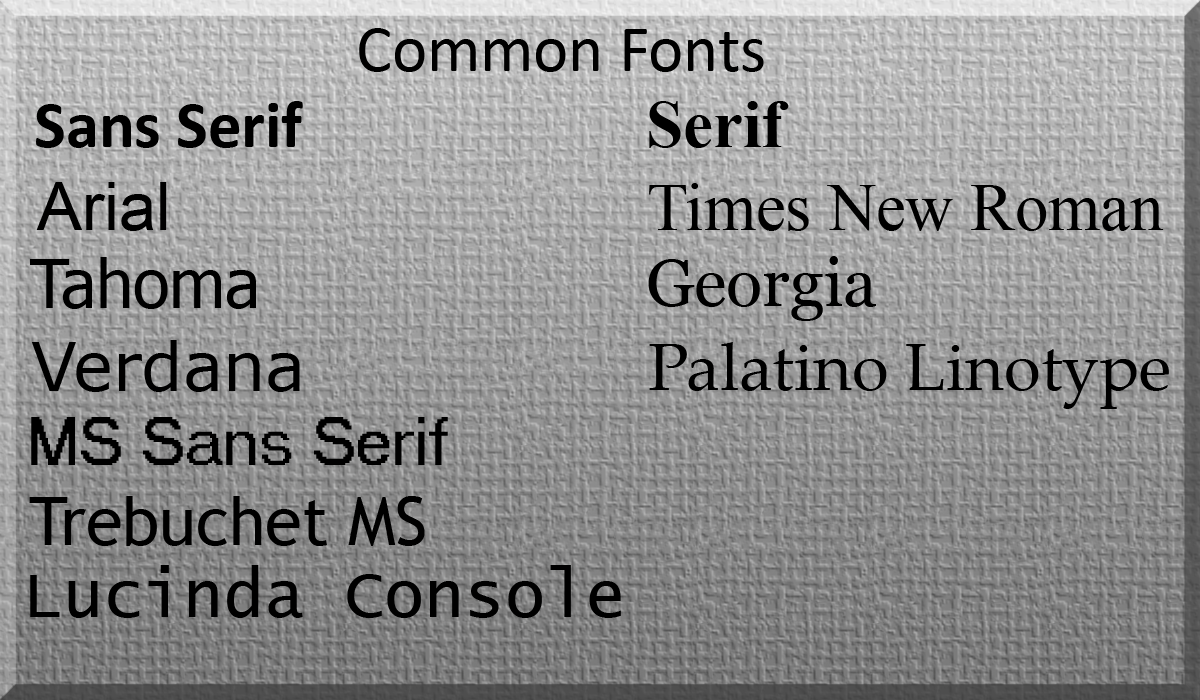
Common Fonts

Sticking with one of these fonts will not guarantee that every reader of your resume will see it exactly the way you want, but it will improve the odds. These fonts are available on more than 90% of the computers on the internet. By contrast, Calibri is on less than half the computers (code style provides statistics on the availability of fonts).

If you absolutely have to use a font that no one else on the planet has, there are options. You can embed the font in the file. Word allows you to do this in the Tools menu under options. Embedding the font will allow a reader of your document to install the font on your system.  Not all fonts can be embedded though.  Some have licensing limitations that prevent this.

You may be bored with Arial or Verdana, but they look reasonably good. Another font may look better, but may also get replaced with something much worse.

KPI’s and Your Resume

KPI’s are Key Performance Indicators. They are the metrics that drive the overall performance of an organization. KPI’s are critical to a company’s success and are an important element in your resume. If you don’t discuss KPI’s on your resume, you should.

A KPI is a measure of an activity that provides an indication of success or failure. Every industry has different metrics that drive performance. You should know the KPI’s that are important in your organization, and how you affect these KPI’s. If you don’t know your KPI’s, you’re going to have a tougher time in your search.

The reason KPI’s are so important is two-fold. First, many hiring managers want to know that a candidate is concerned about how their performance drives the overall success of a company. Discussing your KPI’s can help show that you understand what you need to do to succeed. Second, hiring managers like to see candidates that take responsibility for their performance and are committed to meeting expectations. To meet expectations, you need to know what they are and your performance relative to those expectations. Knowing our KPI’s is a good way to show this to a hiring manager.

KPI’s also help you show how you will drive performance of a team you manage. It is very difficult to drive performance without setting clear expectations and measuring the results. KPI’s are an important element of this.

Examples of KPI’s

Each industry has different challenges and different KPI’s. Below are examples from a manufacturing.

  • Scrap dollars per labor hour

  • Parts produced per labor hour

  • Rework hours per labor hour

  • Production hours to setup hours

  • Maintenance hours per shift

  • Equipment downtime

  • Order backlog

  • Percentage of orders shipped on-time

  • Line fill of orders shipped

This is just a sampling of a few KPI’s. A company may have dozens of metrics that are significant.

Writing About KPI’s

On your resume, you should write about specific KPI’s that are significant to the business. Start by discussing your actions and then provide the change in the KPI. For example, a production manager may have reduced setup times by standardizing tooling:

Reduced Setup Times: Standardized tooling in punch presses by utilizing a consistent mounting configuration. This change reduced setup times from an average to two hours to under 30 minutes. Setup hours per labor hour were reduced by 60% in the punch press workcenter.

This bullet provides a clear action completed by the job seeker. The results of the action are also clear. The job seeker reinforces the results by showing the effect on a KPI. This example provides one additional element that benefits the presentation. It is written with the title “Reduced Setup Times.” This title makes it very easy to scan the resume and see what is important, while reinforcing the results achieved by the job seeker.

If your resume does not detail any KPI’s, review your performance, identify the KPI’s that are important and show how you affected those KPI’s.

Newly published in 2010:  Get the best book for Manufacturing Resumes

Resume Writing for Manufacturing Careers - Front Cover

Search
Books from Palladian
New: July 2011
resume objective statements and professional summaries front cover

Buy the Book
Kindle: $6.99
Print: $12.99

Buy the Book
Print: $19.99

Buy the Book
Print: $12.99

Resume Writing Service
ResumeWriters.com